Showing posts with label Kitchens. Show all posts

Monday, February 13, 2012

Downton Abbey Fever


There is much to love about Downton Abbey. Airing here on PBS as part of "Masterpiece Classics" and now ending its second season, the series is filmed in an historic English estate, there are marvelous clothes and real settings, and the characters are feisty and largely likeable, with fast-paced plots just sudsy enough to keep our interest. It is written by Julian Fellowes, who also wrote the equally frothy motion picture Gosford Park (and whom you may remember as the rascal Killwillie in the Scottish-based Monarch of the Glen, a more modern take on the aristocratic and sporting life that remains in Great Britain). The series is a glimpse into the large scale country house era that once existed on both sides of the Atlantic and, seemingly, something of which we can not get enough. Of course, there are pantries and larders and silver vaults, too.

Carson, the loyal butler of Downton Abbey, awaits his supper below stairs.

As in Gosford Park, Fellowes has created a world where the servant and sire know their position and everything runs within well-oiled systems, precise order, and an awareness of one's place. World War I was a game-changer for all of that, even for our American "aristocracy." What I like about Fellowes' approach is that he pays equal attention to the domestic staff, which outnumbered the family members several times over, as he does the lives of those who are on the receiving end of such loyal service. In the past several decades, the museum world in Britain and the United States has begun to take notice of this importance. No house museum tour is worth its admission without seeing a glimpse into the "below stairs" life. Kitchens, sculleries, pantries, cellars, laundries, and servant bedrooms are now regular parts of most house museum experiences with the names, faces and histories of the domestic staff of a household often researched in detail. [Of course, a love of these spaces fueled my interest in writing, The Pantry-Its History and Modern Uses.]

Stan Hywet Hall in Akron, Ohio is an architectural nod to English manors and an
example of the country house expression in the United States in the early 20th century.

I have always been an Anglophile. This is motivated by architectural and historical interest as much as great literature, a rainy and lush climate (but notice how it never seems to rain at Downton Abbey?), stodgy nursery food and a good cup of tea (OK, and for a brief few pubescent years I read a lot of Regency romances). My great-grandparents, of German and English heritage, were über Anglophiles. In 1912 they set out with their architect and decorator on buying trips to Great Britain to find suitable furnishings–even buying old bits of manors and castles that were for sale–for the Tudor Revival estate they were creating back in Akron, Ohio. Enamored as they were with their British travels (Compton Wynyates and Haddon Hall were especially inspiring), they decided to stay a few extra weeks and went ahead and cancelled their homeward trip on the Titanic in April 1912. Stan Hywet Hall likely owes it ultimate completion to that fateful decision. That it even exists today is because it was signed over in 1957 by the six Seiberling children to a non-profit museum foundation and left as originally furnished and decorated–complete with paintings, china, silver, full cupboards, closets and drawers.


Gertrude Penfield Seiberling, c. 1925.
The house, which opened in 1915, had all of the grandiose trappings of its era and yet always maintained a cozier sense of home and family. There were balls and galas, events in the Music Room, garden parties and large family dinners (F.A. Seiberling, my great-grandfather, was one of nine children who lived in the Akron area and he liked to gather the clan together often). Christmas was a beloved time and my father's childhood Christmases at the manor were a source of many happy memories. On certain occasions, the manor and its grounds were also opened to the public or to employees of Goodyear Tire & Rubber Company. The English would have scoffed, I'm sure, but the attention to detail in the house is transporting and the intended effect has succeeded in the appearance of an estate that has evolved over centuries. Charles Schneider, a Cleveland architect, won the commission because his design was warm and appealing, not at all like the marbled halls of many of the Gilded Age homes in Newport and New York that the Seiberling family found wanting.

Lord and Lady Grantham–
to the manor born in Downton Abbey
Downton Abbey incorporates aspects of the American Gilded Age in the newer wealth of Cora, Lady Grantham's heritage paired with the aristocratic, but slowly impoverished, Edwardian English estate of her husband Lord Grantham. Despite his wife's money, and their three daughters, the estate and its contents must pass by law to the next male heir, ideally with sufficient funds for its maintenance to keep it within direct lineage–an example of the male heir primogeniture holdover of feudal law. Marriages of this kind were not uncommon during this time when wealthy women from American industrial families were paired with English noblemen to infuse dwindling estates with cash and uphold their preservation. Thus, a tentative "marriage of convenience" was forged between pockets of the American nouveau riche and a few bastions of fading English aristocracy.

The F.A. Seiberling family around 1915, after Stan Hywet was completed. My grandfather, James Penfield, is at the upper left, alongside his sister-in-law Henrietta Buckler Seiberling (who would later be instrumental in the creation of Alcoholic's Anonymous), brothers Fred and Willard, and in front (from left), sister Virginia Seiberling Handy, parents F.A. Seiberling and Gertrude Penfield Seiberling, flanking youngest sibling, Franklin, Jr., and sister Irene S. Harrison.


One of the many reasons I continue to enjoy Stan Hywet today is because it is the only repository of family memory that I have left in Akron: we long ago left the small house across town where I grew up and my grandparents' home, just up the road from Stan Hywet, was sold in 1983. Where there were once several dozen staff, by the end of World War II there were only a few servants (and the once well-manicured grounds more or less went wild). Meanwhile, my father's household in a comfortable 1923 Spanish Mission style house nearby had two live-in staff and several hired as needed. He and my mother spent their married years in a much smaller suburban Colonial, across town, with no maids. By the 1960s, the world that my family had known no longer existed and paralleled the demise of the midwestern Rust Belt's industrial heyday. While I can't deny that I am grateful for a glimpse into this other world––or that I take pride in my heritage on both sides of my family––at the same time I am blessed to have had a grounded upbringing from each of my parents that focused on values, kindness and the merits of a good education: part middle class suburban offerings and part New Hampshire farm.

F.A. Seiberling in front of Stan Hywet in 1942.
It's fun to speculate "what if?" What if the family had returned on the Titanic? Would Stan Hywet still have been built? What if there hadn't been a hostile takeover of Goodyear Tire & Rubber in 1921? What if the family had still been involved with Goodyear and never founded Seiberling Tire & Rubber (when F.A. lost Goodyear he turned around after a few months and started another tire company, which stayed in the family until a corporate raid in 1960)? What if the family still owned Stan Hywet? Would there have been a pattern of primogeniture as there was in Great Britain or would my grandfather, the second of two sons, who ran Seiberling Tire after his father passed the baton, been the heir apparent to the home? The speculation is fun but the reality is that, in deeding the entire estate and its contents in 1957, the six siblings guaranteed that the property and grounds would never be divided, sold or destroyed. Today it continues to live up to its noblesse oblige Latin motto carved over the door: "Non Nobis Solum" (Not for us alone) with a well-preserved house, collections and accurately restored landscapes and gardens. [Meanwhile, Highclere Castle, the very English and historic setting of Downton Abbey, remains privately owned through direct lineage of the Carnarvon family since 1679, and is also open to the public.]


So as my husband and I watch Downton Abbey from our humble doublewide on our Kentucky farm, it seems a rather strange way of glimpsing a reassuring sense of order and family life in a changing world. While the fictional characters in the household of Downton Abbey mourn the way it was before World War I, nearly one hundred years later we look back at a past we did, or did not, know with the same, odd kind of longing. No matter what era we're in, it's usually about one's sense of place in the world, family hierarchy and relations, a well-appointed house (or hopes and plans of one), great dinner parties, and the intricacies of romance and relationships. Strong and imperious no-nonsense matriarchs with great one-liners go a long way, too, even if snark was probably not very fashionable in those days. I want to be like the Dowager Countess when I grow up! And, while we're being silly (sort of), a devoted butler would be fabulous.

Thursday, October 6, 2011

At a Newsstand Near You! Yummy Kitchens-and pantries!

Just a note to say that if you are looking for some great ideas for your new or old kitchen, inspired by vintage and historic prototypes, Old House Journal and Old-House Interiors magazines have joined forces to produce a special issue, Kitchen Classics. It is available for a limited time at larger bookstores and/or certain magazine stands (and possibly via their website, although I'm not certain).

The editors were also kind to include two articles I had written several years back for Old-House Interiors on pantries and Hoosier cabinets. It is online here (although the layout in the magazine––with more photographs–-is much better!). The publication of the original pantry article was what inspired me to put together the book proposal for The Pantry.

This special issue is a keeper for any kitchen (and pantry) enthusiast for new-old design ideas, resources and wonderful photography. I'm going to tuck it away in my file marked "Future Farmhouse Kitchen." I can dream, can't I?

In the meantime, I've been promising photos of our new cottage pantry at the farm which is a great stand-in for the time being: we don't live in the cottage because it is too small for all of us, so, naturally, I have adopted it. [And it will one day be our 'doty house' for our older years.] It also has a great canning kitchen that has been in constant use these past two months. So, I will make those photos a priority as soon as I get organized post-canning!

Best wishes and have a lovely autumn season wherever you may be,

Catherine

Tuesday, July 17, 2007

Kool Retro Food Memories (or Cool Whip-R-Us)


12
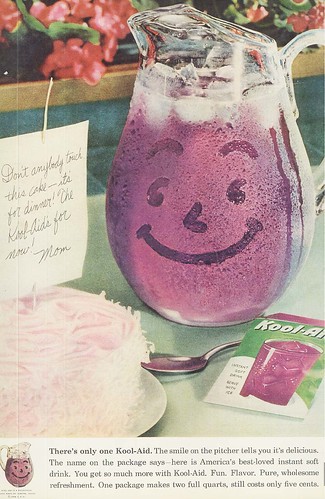
Doesn't that image just bring a smile to your face and make you want to run to the refrigerator and grab a glass of ice-cold fake purple-colored, artificially grape-flavored sugar water? Well, maybe not today but it certainly used to do when I was a little girl begging my mother for some Kool-Aid™ (she'd occasionally cave to my pleas––and "PLEASE?"––in the store). I can't tell you how much I wanted a glass pitcher so I could make a smiley face on the wet perspiration. Instead, we managed with the latest Tupperware™ pitchers with the easy-open pop tops. [Even then I seemed aware that glass made everything taste better.]

I am a child of the 1960s and all of the "modern" food conveniences that were allowed. My mother, an excellent cook and like many of her friends, didn't want to spend too much time in the kitchen unless it was a special occasion or a spree of Christmas baking. Even though they were all stay-at-home-moms in that era, the emphasis was on ease and convenience and not artisanal or whole-food anything (that revival would begin, slowly, in the 1970s). That said, I remember shopping almost daily with my Mom and my brothers at Bisson's Market on West Market Street in Akron, Ohio. It was a small but fine specialty market with an emphasis on good meats and spectacular produce and within a minute by car from our house. Mr. Szabo (I may be spelling that wrong) always popped out of the back and gave us some Brach's candy from the produce section that he managed. As we weren't allowed candy in our house, except at Halloween, that was always a special treat for us. "Just one a piece," my mother would say. No wonder I craved sugar.

It was likely my parents' perseverance, as well as the fluoridated Akron water and twice yearly dental visits, that kept us cavity-free throughout our childhoods. [I was also a certified member of the post-War Baby Boomer "Clean Plate Club" but that is another study in residual childhood food issues, as well as a persistent aversion to lima beans and liver. But I don't blame my parents for turning me into a wayward Foodie--that is just a part of my DNA.]

My Mom, circa 1965, in her pink 1950s suburban Akron, Ohio kitchen.
[NOTE the pink Pyrex™ bowl and her Betty Crocker cookbooks.]

Of course, Mom bought fresh and healthy foods but I noticed an increasing reliance on new foods from the era, ones that food purists today run screaming away from with one look at their labels. Cool Whip™ soon became an essential ingredient of her simple but elegant Strawberry Cake, likely because it could withstand the Ohio summer heat and humidity when placed on the picnic table. Meanwhile, chocolate Whip-n-Chill™ (also available in vanilla and strawberry flavors) was a dessert staple. I remember when they stopped making it--was it all those chemicals and additives? All I know is that it tasted like chocolate clouds, cold and creamy and light. In Florida, my Great Aunt Fran not only made the best Key Lime Pie (with Key limes from her back yard), which I failed to appreciate at a young age, but the very best Whip-n-Chill™ pie. A few years ago I bought some chocolate Whip-n-Chill™, still made by Jello™ but sold only in Canada (like an illicit drug or something), that was distributed through Vermont Country Store (a great place to get retro anything, even when it isn't yet retro). For some reason it still sits unopened in our pantry. Am I afraid it will disappoint? Surely it will not spoil in its dried chemical vacuum-sealed state.

Yes, I have this (as yet unused) cookbook! Chemical confections for every palate!

Later, I believe it was Jello™ that made 1-2-3™ that separated into three layers of the same color but different textures and hues when it set (who knows what lethal combustion of chemicals that required?). That was never as popular in our house but years later when I was writing The Pantry, I learned it had been a favorite in my friend Edie's childhood (and making it in her grandparents' pantry a beloved summer memory). In the early 1970s my mother began to submit to Hamburger Helper™ and like products from Betty Crocker™. Sloppy Joes, a family favorite excepting me, were made with a powdered mix added to onions and hamburger, and heated in the electric skillet before being slopped, warm, on top of Wonder-breadish hamburger buns. Wonder Bread™! I can still see the red, yellow and blue polka dots on the white wrapper but my more esteemed culinary palate hasn't tasted it in years.

Perhaps this is one reason I became nostalgic for pantries before I could even articulate the concept: we just had a broom closet in our small 1950s post-War pink and black kitchen and my mother did not store a lot of food simply because we didn't have the room. With a market around the corner selling the latest processed food products, who needed an old-fashioned pantry? Instead, breakfast nooks were included in new kitchen designs and families ate together in the kitchen. The days of the butler, or even a waitress for an upwardly mobile middle class family, had ended with the First World War.

Going to the grocery store was a social occasion for a stay-at-home Mom on any budget. Our pink fridge, an appliance color that I did not appreciate until recently (even though I would not dare use it today), became another kind of pantry with its freezer and ice box capacity. Meanwhile, homogenized milk and dairy products arrived several times a week from a Reiter Dairy milk man in an insulated tin box on the back step (or "stoop" as we said in Ohio, certainly from the strong Midwestern Germanic influence).

Me, c. 1965, no doubt waiting for a chocolate chip cookie.

But I loved the concept of processed food and the whole marketing pitch and packaging that went with it. I noticed these things because I studied the ads in the house and garden magazines I poured over in the living room (or even in black and white ads on television). I feared the tall, bald Mr. Clean™ in the household aisle of the grocer's as much as I thought the Jolly Green Giant™ would reach right out of the freezer case and put me into a bushel of peas. These guys were as real and looming for me as the Big Bad Wolf.

In my pink-cardboard play kitchen under the cellar stairs, along with my fake food!

Another culinary fixture of growing up in the 1960s was the frequent use of Betty Crocker's Picture Cookbook (I believe the 1956 edition), as well as Betty Crocker's Cooky Cookbook of the same era. Both had been bridal shower gifts to my mother in 1961 and were the kitchen bibles and some of the only cookbooks she owned at the time. I enjoyed looking at the images of brightly colored plates and food styling, even before I could read, and eventually learned to bake and cook from those books (once I'd graduated from my aqua Easy Bake Oven™). My mother made Cottage Pudding and Golden Sauce on the rare occasion that my Grandpa came for dinner and different cookies from the "Cookie of the Year" section at the back: especially the Toll House (1946, I think?). When my parents bought a wok in the early 1970s the first thing they made was Sweet & Sour Pork--my mother labored over it all day while my father kept us away from the kitchen, knowing that we'd blanch at the thought of having to eat something so exotic (he was right).

af_1.JPG
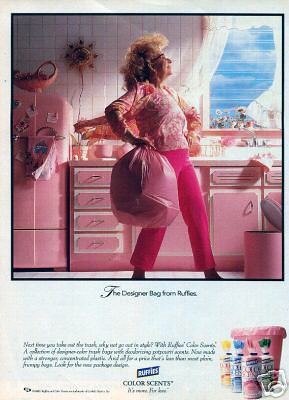
The Pink Kitchen Strikes Again! (ad from early 1990s)
I'm not as nostalgic for these foods for their flavor as I likely am for their associations and vivid packaging. I would not dream of buying Hostess Twinkies™ or Ho-Hos™ or Hamburger Helper™ today for my children--instead, I try to make them myself, supplementing chocolate whoopie pies or sponge cake or Tailgate Casserole (a delicious ghoulash of egg noodles, hamburger, several kinds of cheeses, and tomato sauce all layered together) for the boxed foods of the past and present. But the Pillsbury™ Dough Boy can visit my kitchen anytime, and often does, when I just don't feel like making homemade biscuits. [Come on, I'm not that much of a food snob! Even though I'm not sure what comprises the crystallized chunks of transluscent grease in their Grands™ biscuits...]

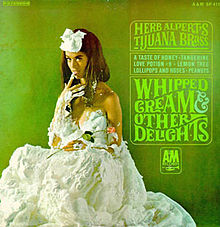
Once in a while I'll get a craving for a Fresca™[remember when they made it like Sprite in the 80s and then, thankfully, changed it back again?]. I'll pop a can open and pour it over a tall glass full of ice, take a sip, and be transported back to Akron on its grapefruited effervescence. It's a hot summer's day in the 1970s, I'm watching billowing clouds pass over our small suburban lawnscape and I hear the bubbly, happy sounds of Herb Alpert & the Tijauna Brass wafting from the hi-fi inside, perhaps from the album Whipped Cream and Other Delights. And I'll bet that model was covered in Cool Whip™.


POSTSCRIPT July 18: I really should add that Herb Alpert and the TJB were Grand Marshalls of the Akron Soap Box Derby Parade one year in Akron––I'm guessing late 60s as I couldn't have been much older than five. My mother, who was home with my baby twin brothers, couldn't attend. My father, who was branch manager of a bank dowtown along the parade route, was able to get me, and our friends Diane and Bill, in the bank after hours to watch the parade. I'll never forget Diane, who like my mother thought Herb Alpert was the cutest thing (he was!), hanging out the second story window, in between fluted limestone columns, as the float went by. "Up here, Herb!" she yelled and waved amidst the noise of the band. He looked up at us and flashed that magic smile. I see him now, one of those indelible images from childhood memory, the float in slow motion and the colored ticker-tape and confetti raining down. A magic summer moment. But I've always been sorry that my mother missed it.