
Showing posts with label Weather. Show all posts

Tuesday, May 4, 2010

"The quality of mercy is not strained..."

South Fork Creek Road on Monday morning, after the historic flood of May 2nd.
When we saw the road on Sunday evening, at almost peak, it was impassable
and the water had risen to the top of the signs at right.


In my freshman year of high school, one of my best teachers along the way, Anne Sirois Pelletier had us memorize Portia's courtroom speech in The Merchant of Venice by William Shakespeare.

It begins:
"The quality of mercy is not strained.
It droppeth as the gentle rain from heaven
Upon the place beneath.
It is twice blest–
It blesseth him that gives
and him that takes."
I thought of this passage over the weekend as we got record-breaking rain in many parts of the South. I'd been praying for some rain for weeks–selfishly because of the awful tree pollen this year but also for all farmers and gardeners who rely on the rain to make things lush or to fill water tables. The irony is, of course, that in Shakespearean English "strained" actually means forced–so mercy, according to Portia, should not be so. It should be gentle and for all, no matter whom. However, as Ralph Waldo Emerson once said, "The good rain, like the bad preacher, does not know when to leave off." [Yet Mark Twain also noted, "Water, taken in moderation, cannot hurt any body."]

We were blessed to get the rain we needed on our ridge and that it didn't destroy anything, except to carve a few unwanted channels in newly seeded areas. [And I did discover, just today because I happened to be listening to a local radio station, that the roads on our ridge are on a boil order–no idea why and it would have been nice if they'd called us!] Other parts of the region were not so fortunate. The Highway 127 bypass around Liberty was flooded from Green River (it is located on a flood plain but no one has seen this kind of flooding in years) and many businesses were affected. Historic Penn's Store, which I have often visited and blogged about, located in northern Casey County, has also announced that due to flooding, they will be closed indefinitely. There were only a few flood-related deaths in the state but many homes and bridges were damaged or destroyed in low-lying areas.

On Sunday night we drove down to our creek farm. It is only a mile away but the passage from our home on this ridge can be treacherous even in good weather. So we went the nine or so miles around over to the next ridge and down, with occasional moments along the way of crossing water on the roads, even on high ground. I have never seen our creek so fast and furious. We could barely speak over the rushing water and the entire creek bed was full of it, some twenty five feet across and easily five feet high in places, with still higher rapids. Where the branch ran into the larger creek–and where we can normally cross the ford in drier weather and lower water–there was another rush of broiling, angry murk. Filled with sticks and logs and other debris, it was not safe to near it and yet, as at the side of Niagara Falls where it goes "over the drink," as my father used to say, there is this strange pull towards its sheer force and powerful beauty.

Not long after we arrived, with my husband and sons further down the bank, I watched as a good-sized black walnut tree dislodged itself from the banking. It was as if a giant had just pushed it out, as we humans might pull a willing weed. It was soon heading downstream and I hollered at them to watch out. By the time it rounded the bend at the ford and joined the larger creek, it had been stripped of all of its limbs. It all seemed to happen slowly and deliberately, as if in a dream.

Next we headed back up the ridge and over to South Fork Creek–or what we like to call the Mennonite valley–to see what was happening there and to check on some friends. We entered the back way on higher ground and soon realized as we came down into the creek area, near several stores like Sunny Valley, that we would not be able to pass. The water had flooded the banks into the fields and over the roads in many places, some two or three feet. When we came down a hill towards another state road we looked out towards Highway 127, about seven miles south of Liberty. All of the pastures in the Green River valley were an ocean of brown water with small islands of trees here and there. I'd never seen anything like this before except in a disaster movie.

We met people we knew on the road and many friends, out looking like we were, and learned that school would be canceled in the county the next day. We were certain that the boys' school would be, also, as there would be few, if any, ways to reach it on the ridge where it is located above South Fork Creek. We also learned that the Highway 127 bypass near downtown Liberty, the Casey County seat, had been closed because of excessive flooding of the businesses and residences along the way. As it began to get dark, and with fewer options home, we headed back over high ground to our farm on the other side of the Casey County line.

Two empty oil tanks floated up from beneath the pavement on Hwy 127.
We frequent many businesses in this section of town and 80% were affected.
The volleyball nets in Gateway Park in Liberty captured river debris as it passed–but the force of water was not strong enough to move the Army tank.

For some reason, I forgot to bring my camera the night of the flooding. I'm realizing it is OK to experience life without one sometimes, but this would have been one of those occasions, and unfortunate historic events, where it might have been a good idea. The next morning we did go out again, to a glorious sunny day, and saw that the flood had receded but the damage was done. Maybe this is what Noah and the people and animals on his ark may have felt after the flood as they watched the blue skies and white clouds and perhaps felt the sorrow of an Earth changed but cleansed.


One of our sons asked, "Where did all that water go?" Where, indeed. It is my understanding that the area's rich and abundant bottom lands and quiet hollers were once the bottom of an ocean. The salt water receded and fresh water from the eventual glacier melts carved the long-fingered ridges that form our knob region. It was not hard to see on Sunday night how water carved these hills and creeks and ridges and occasional palisades that form south-central Kentucky's beautiful and rugged landscape. By Monday morning, less than twelve hours after their height, the waters had receded again back into the Earth.
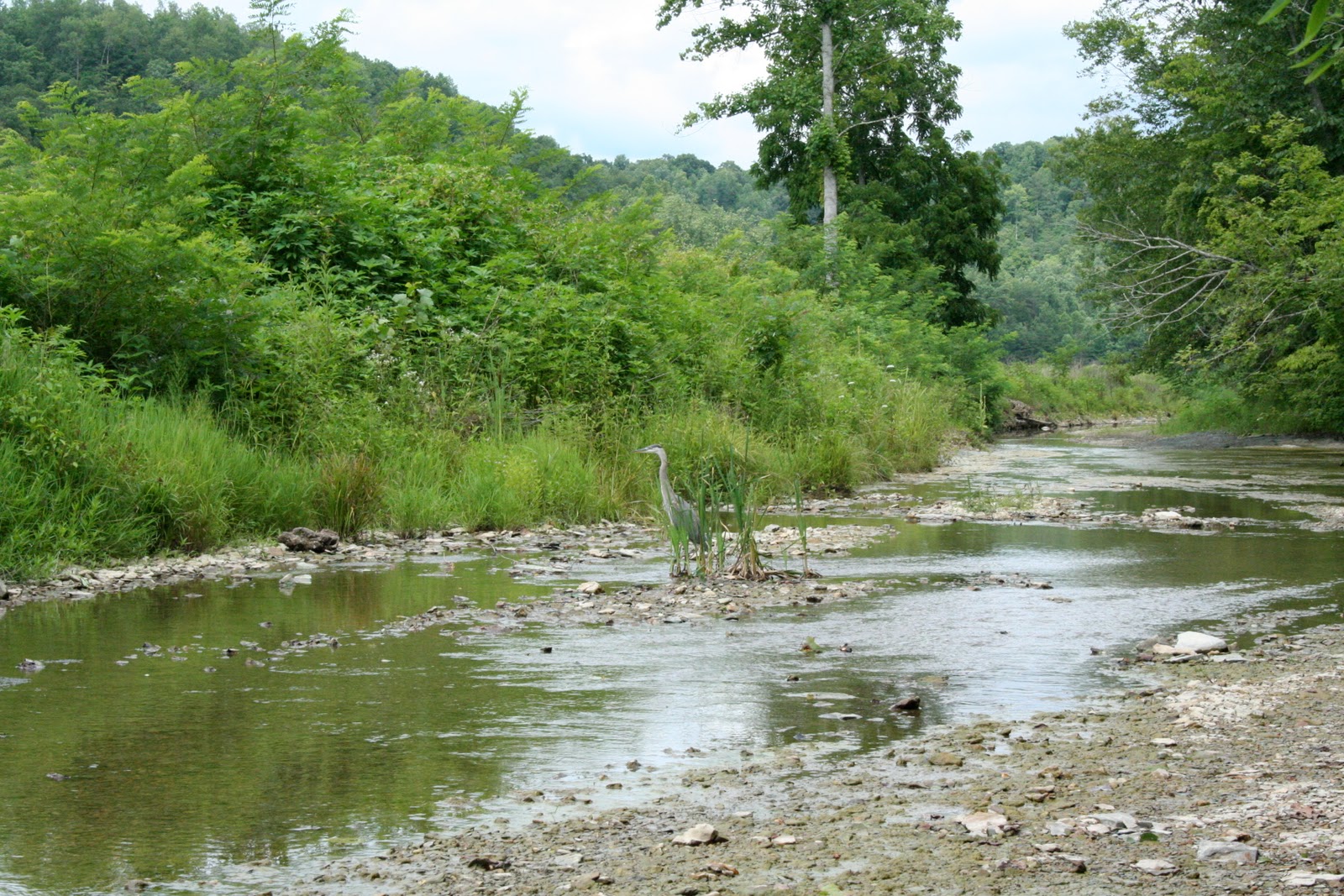
Our creek in quieter times–note the Great Blue Heron on the little island.

There is a passage in the novel A River Runs Through It by Norman Maclean that describes the interconnectedness that we share with water. We humans are mostly water, of course, and we need it to function and to live, like all life forms. But there are times that we need its mercy, too.
"Eventually, all things merge into one, and a river runs through it. The river was cut by the world's great flood and runs over rocks from the basement of time. On some of the rocks are timeless raindrops. Under the rocks are the words, and some of the words are theirs. I am haunted by waters."
~ Norman Maclean, A River Runs Through It

I have a new respect for the power of water and how it can be a mere drop, or a gentle rain or a raging torrent from the heavens. It is an element, like all of the others, that must be respected. And I now better understand an oft said Appalachian expression, "The good Lord willing, and the creek don't rise."
+   +   +

Last Friday we attended the local Mennonite community's first Haitian Relief Auction. It was a pleasure to buy a locally-made picnic table and benches, a much-needed garden cart, some new baking dishes, as well as delicious barbecued chicken dinners, fruits, vegetables, pie and other baked goods and to know that 100% of our money will go to Haiti through Christian Aid Ministries. I was disappointed that more in the local community did not attend beyond the local Mennonites and Amish, who also came from other states to be there and bid on items they could easily have made themselves (many fine quilts, for example). But it was the first such auction held by the local Mennonite community, it was held on a Friday and next year will be on Saturday, April 30th. I'm sure there will be more people attending next year.

Sometimes misfortune hits closer to home, too, as in a flood of this kind of proportion and devastation. In the coming months there will no doubt be more relief efforts for local families and businesses in need. Our thoughts and prayers go out to those who have suffered from the devastation of the flood waters. Many of those affected live below the poverty line and have no insurance. If you would like to help those in Casey County who have been hard hit–both residents and businesses alike–you can give through a fund set up through the Liberty-Casey County Chamber of Commerce. For more news and photos on the flooding and its aftermath, you can follow coverage at The Casey County News.
Also, If you buy a copy of The Pantry this month, I will happily sell it to you for a reduced rate of $12, including postage, and donate $5 from every book sold to the Liberty and Casey County Disaster Relief. Email me at info@CatherinePond.com and I will bill you directly via PayPal or you may send me a check. If you've already ordered a copy of The Pantry since May 1st, I will also donate $5 from each copy sold. 
Please spread the word! I will sign and send your book to you or your mother, a teacher, sister, friend, or anyone who loves pantries and old kitchens and the security and comfort that they provide.
Thank you ~

Catherine

Saturday, January 9, 2010

Snow Days


Eli led the way to the sleds, which surprised me as I'd forgotten all about them, and then I only had to give Henry a nudge out the door and the promise of homemade cocoa later on. Once outside they had an absolute blast. Who knows, I might even join them tomorrow!? [But I don't have a Carhartt® jumpsuit!]

Assembled winter decor on our mantel. The little log cabin came with balsam incense years ago. Our son Eli made the popsicle stick snowman in school this December and the painted outhouse was made by local artist and historic Penn's Store owner, Jeanne Penn Lane, over in Casey County, near the Forkland community and Gravel Switch. [I've blogged about Penn's Store several times in the past few years.]

I didn't realize how much I actually missed having snow around in winter until our two "snow events" in the past month. The first storm was a sloppy slushy snow which barely lasted a day but gave us about 4 inches for a brief time. The snow didn't pack on the roads and melted quickly–those kinds of storms can produce ice or a treacherous "icy mix," however. It happened a week before Christmas and just got us all into the spirit of things, especially while I was getting packages shipped off via the U.S. Postal Service's "if it ships–it fits" campaign (not only that, the packages got everywhere they were supposed to by Christmas Eve: for one price, flat rate and mailed within a week before Christmas Eve–I'm sold on that concept or maybe it was the luck and good spirit from a festive snow storm).


I bought that lit cabin a few years before we moved here–little did I know that it is a reminder of a Kentucky-style home place. The "Frosty" hat was bought at a nearby local craft store in Liberty, Kentucky. I like to pick up handcrafts whenever possible, especially for the holidays.

The past few days we've had flurries and periods of snowfall. We've also had sustained cold which guarantees that the snow will stick around a bit. While it's just barely a few inches, at least on our ridge, I now understand why they cancel school so readily down here: our ridge road is 8 miles long and it hasn't been plowed, or at least sanded or salted. Meanwhile, the state highways and parkway are supposedly fine. However, our road, more like a long driveway/lane that connects between two points of our ridge road (which makes it lovely and private), is quite hilly and treacherous right now because it has nothing on it to treat it. Our wimpy Toyota 2-wheel drive remains at the bottom of the driveway. Even our 4-wheel drive Honda Pilot is not too happy about climbing our hills with these road conditions.


Dashing past the chicken house...

The other factor about roads here is that they are usually narrow with few, if any, guard rails, let alone any shoulders for emergency breakdowns. I'm not complaining except to say that people drive way too fast in general and it's always the other guy I worry about. [Or maybe it's just advancing old age and I'm becoming more cautious.] Our neighbors and friends tell of us of heavier winters, back in their childhoods within the past fifty years, of such heavy snow fall that school would be canceled not just for a few days or a week, but often a few months. Talk about cabin fever! An ice storm hit our ridge several years ago, before we moved here, and people were without power for several weeks–the same thing happened just a bit north of us last January. It's good "in these parts" to have a full pantry and root cellar, a reliable spring, a wood stove and perhaps even a generator. [Just remember if you have a tomten or two around your farmyard to leave him some food and warm hay to keep on his good side.]


The red tin match holder was an eBay purchase a few years ago–part of the estate of a Kentucky farm and only a few dollars.

Another eBay "find" and a gift to my husband a few years ago was this Warfield cardinal, a rare catch on eBay and I was astonished at the bargain. Robert and Virginia Warfield used to carve and paint birds (he carved and she painted) in my hometown of Jaffrey, New Hampshire and became quite renowned for them. Their cardinal graces our mantel year round and I was reminded today–with a flurry of birds raiding the dog food on the back porch–that I need to get a good feeder and seed this week.

With the sustained cold for a few more days we're guaranteed that the snow will stick around a bit longer. We're making the most of our possibly brief glimpse of winter weather–a window on the old-fashioned kind of winters we used to know that aren't mixed with sleet or just damp rain for four months. It's still a great pleasure to know there are four seasons in Kentucky–but with a shorter, generally milder, winter. [But hey, remember all of those squirrels running around all fall for nuts and how cold October was here? If you believe the old-timers and folklore, which I generally do, signs were pointing to a colder, snowier winter.] PHOTO–What, you don't have a bobble-headed gnome in your home? A gift from my friend Linda a few years ago with a "Snow" ornament sent from my dear sister-in-law (the gnome is out all year).


Aunt Cynthia amidst the post-Christmas decoration pick-up. We both like to make "meany faces" at each other. Sometimes it is a guaranteed cure-all for cabin fever! [And she loves the Christmas sweater we gave her a few years ago.]

This weekend I've been (slowly) putting away our Christmas decorations. It's not that I want them lingering around but that I actually hate to pick them back up again and put them away–but once I do, it feels like a new year and a clean slate again. So, because I also enjoy some holiday decor throughout the seasons, and we are down to one mantelpiece, I decided to do an homage to winter for another month or so–OK, until the end of February. PHOTO–My sister-in-law gave me this primitive-style snowman just this Christmas (with a Cracker Barrel® gift certificate–yee ha! We all enjoyed that last weekend already) and I love it.

I have a growing collection of snow men–some vintage, some made by our children, some made locally, and some made in Occupied Japan or more recently, China. [Sometimes I wonder what I don't collect...] It was fun to redo the mantel with some lingering Christmas decorations, that didn't exactly say "Christmas" (alright, yes, two of the snow people are holding a "Noël" sign)–and that could segue well into "winter decorations." And, to be honest with you, right now it is the most orderly part of the house–so I look at that mantel and its tranquil snow scene and I think, yes, it is possible to organize things and have them in some kind of harmony around here. PHOTO–The salt & pepper snow people were $1 finds at Dollar General last Christmas. And yes, I'm not above buying cheap "junk" from China on occasion, especially if it's well made. And besides, the kids love them.


We're hunkering in for the rest of the weekend and dealing with some frozen pipes at Ida's house across the street. I'm doing a lot of cooking (I'll post some recipes tomorrow) and relaxing. I was supposed to have friends for lunch on Monday but with the freeze lasting through then, pipe stress, and the state of our driveway and lane, I decided to enact our "snow date" instead. By Martin Luther King Monday, who knows? It will likely be back in the 50s again, our winter magic put away for another time.
Some winter scenes from a vintage c. 1950s linen Christmas apron in my collection–the recent snow makes it feel like Christmas all over again.

Snow or no snow, may your days be merry and bright all the year!

Tuesday, November 3, 2009

Pushing Night Away and Chasing Down the Moon


The full "Beaver Moon" on November 2, 2009 [also "All Soul's Day"] rising over Green River Knob, the highest point of land in Kentucky west of the Appalachians in the eastern part of the state. It watches over Casey County and our farm land on the other side to the east. At first I though the purple haze was a storm front, but it was night arriving from the east.

Last night I had one of my usual sublime, but often comical, experiences in the face of things.
I was driving home through South Fork Creek valley in Casey County at about 5:15pm (new time). The fading autumn light had that purplish golden glow on the umber foliage and cornstalks. And then Green River Knob, our "Monadnock" of Kentucky (both in presence and geographic definition) went all "purple mountain majesty" on me. It was breathtaking.

As I rounded the bend near the Baldock chapel, I caught a glimpse of something large, white and darting behind Green River Knob. At first I thought someone had erected a silo and that it was its metal dome top, large and gleaming. But it was bigger: the moon, of course, silly! As it hid again behind the knobs, I dashed to get up to the next ridge. In my brief, fleeting glimpse it was huge and saucer-like, as big a full moon as I'd ever seen! By the time I got back up on the ridge, it was much higher, still large, but much smaller than it had been hovering right on the horizon–I'm going to try again tonight to "chase" it, but maybe from our own knob this time!


Here, I must say again, that the skies of south-central Kentucky intrigue me. We have such a span of sky that arcs from east to west and all around us, a continuing orb of horizon and comings and goings. It is like this in the Midwest and West, I realize, but I had forgotten the "big sky" quality of life after so many years in New England where trees line the roads and there are few open horizons, at least in our part of New Hampshire. It is quite expansive for the soul and mind to have such a vista, rather like the same feeling of living on the ocean, but here we have an endlessly rolling stretch of land all around us and that can be comforting and freeing at times, and also binding, like a well-made old patchwork quilt of many fabrics. [Remember "The Land of Counterpane" from Robert Louis Stevenson's A Child's Garden of Verses?: "I was the giant great and still that sits upon the pillow-hill, and sees before him dale and plain, the pleasant land of counterpane."]


View to the east on Hopeful School Road–we also have Hopeful Church Road on our ridge. I love both names and sometime hope to find out more about their origin.

One phenomenon that I've noticed here on clear early morning drives to school or sunset drives home is that you can see the push of night as it heads west or arrives from the east. Behind Green Knob to the east, where the moon was rising, it seemed that there was a murky haze coming in, like a distant storm front. I thought at first it must be that or either some kind of wall cloud. But I remembered, no, that fronts rarely come from east to west, unless you are in the northeast and experience the ocean storm front known as a "Nor'easter."

When I got up on the ridge again and saw the moon behind Green River Knob, and looked to the right and saw the sunset just opposite to the west, I became aware that what I was seeing was actually the wall of night advancing, quietly rolling in like fog from the ocean. To the west I watched the light retreating. In the morning it is just the opposite: as we drive westward on Route 80 we seem to be pushing the wall of night ahead of us as dawn arrives (before Daylight Savings we would leave the house before sunrise so we would watch the day arrive as we made the 20 minute drive to school each morning). I have never had that experience before.


My now 21-year old daughter used to stand in her crib as a child and point out the window to the full moon, "Da Moon!" she would exclaim, her eyes wide with excitement: "Da Moon!"

As well as being able to better respond to the light here, we can watch weather patterns and changing clouds. Halloween provided us with a particular sunset pageant of golden light changing to purple on low clouds. Last night the sunset was more luminous, with blue and orange patches on minimal clouds.


So I pulled over to attempt to take photographs. I've included most of them in this blog entry. The Hudson River painters and Maxfield Parrish have done much better jobs of depicting skies like these on canvas. I laughed at my attempts to capture the moon, although I know photographers have done better than I. I realized that such beauty is meant to be experienced and deeply felt, not necessarily recorded. I was reminded that we plan, God laughs! The universe is vast and great and even trying to capture such sublime beauty in words or photographs is futile. Even this blog is a feeble attempt to share what I saw and felt last night but I do so anyway because humankind has always tried to express such emotion in writing and in art.

But what I saw was beauty–and majesty.


An old tobacco barn on Route 80 in Pulaski County–trying to capture this view was a bit risky with no shoulders and walking along at dusk with busy traffic. If more people could slow down and see what's around them, the world would be a better place–it would be nice if people would at least just slow down when they drive, even if they don't want to see the view.

My attempts to photograph were also just silly off of busy Route 80 where people were driving way too fast at the end of their days and I was risking my life just trying to slow down and see the beautiful pageant of light and moon and sunset. Clearly they were not and I need to recognize that not everyone can or wants to take the time to be in the moment or the notion of "Be still and know that I am God" (Psalm 46:10) [Besides, it is hard to "be still" at all on a busy thoroughfare–so I had better luck on the back roads while trying to chase the moon.] I thought, too, of how the moon is everywhere around us and on the Earth, seen by all people at different times and in different guises. Even if we can not see it behind a veil of cloud or darkness, we know it is there, like God.

One of my favorite memoirs about place (and movies, too) is Out of Africa by Danish novelist and short story writer, Isak Dinesen. Her descriptions of her African farm, the natives and her experiences there are poetic and at times, like the best writing, transcendent. [Kamante, her native, and Christian, manservant, spoke this line in the movie that was not in the book: "God is great, Msabu."]

Here is a conversation with a "very old Kikuyu" in the aftermath of one of many flying trips she took with her lover, Denys Finch-Hatton. It rather points to our futile attempt to capture beauty or even come close to God in nature:

"Did you see God?" he asked.

"No,
Ndwetti," I said, "we did not see God."

"Aha, then you were not up high enough," he said, "but now tell me: do you think that you will be able to get up high enough to see him?"

"I do not know,
Ndwetti," I said.

"And you,
Bedar," he said, turning to Denys, "what do you think? Will you get up high enough in your aeroplane to see God?"

"Really I do not know," said Denys.

"Then," said
Ndwetti, "I do not know at all why you two go on flying."


THE ROAD HOME: The bend in the road that divides our farmland –we've just cleared on the left for new fencing. Our knob is also to the left (I say "our" because we own it–at least while on the Earth!).

Here are two poems about the moon which describe it better than I could do, or can portray by camera (and of course they are by two of my favorite American poets, Frost and Dickinson...mmm, sounds like the name of a really good literary agency–one of my winter projects, actually: to find an agent who will take me on–for richer, for poorer, for better, for worse):

The Freedom of the Moon

I've tried the new moon tilted in the air
Above a hazy tree-and-farmhouse cluster
As you might try a jewel in your hair.
I've tried it fine with little breadth of luster,
Alone, or in one ornament combining
With one first-water start almost shining.

I put it shining anywhere I please.
By walking slowly on some evening later,
I've pulled it from a crate of crooked trees,
And brought it over glossy water, greater,
And dropped it in, and seen the image wallow,
The color run, all sorts of wonder follow.

by Robert Frost
The Moon

The moon was but a chin of gold
A night or two ago,
And now she turns her perfect face
Upon the world below.
Her forehead is of amplest blond;
Her cheek like a beryl stone;
Her eye unto the summer dew
The likest I have known.
Her lips of amber never part;
But what must be the smile
Upon her friend she could bestow
Were such her silver ill!
And what a privilege to be
But the remotest star!
For certainly her way might pass
Beside your twinkling door.
Her bonnet is the firmament,
The universe her shoe,
The stars the trinkets at her belt,
Her dimities of blue.
by Emily Dickinson

My barn having burned to the ground, I can now see the moon. [Japanese poet, Masahide]

Thursday, May 21, 2009

Ascension Day


View of our knob pasture from Morgan Cemetery, Ascension Day, May 21, 2009

On the eve of May 21 I went up to the large rise of land behind our house at sunset, called "the knob" by locals, the highest point of land on our long ridge and which comprises half of our farm here. I discovered that the next day was Ascension Day, honored by our Mennonite friends and many Christians as a significant feast day: the 40th day after Christ's crucifixion when he rose into heaven. This had significance to me because I feel at times on the knob so near the sky that I could touch it. And it seems, in its separate otherness and beauty, like many remote places on the earth, to have its own spiritual climate.


View to the east on our knob, sunset, May 20th, 2009


Sunset over Green River Knob from the top of our knob, May 20, 2009


Knob field at noon, Ascension Day, May 21st, 2009

Our weather this week has been spectacular: dry, hot, blue skies and sunny (with cooler nights). It has been well-deserved. It has also been fine haying weather and most farmers have taken advantage of this stretch. Our hay was cut on the knob in large round, 500-pound bales. At sunset, sunrise the next day, and again at noon, they stood like scattered sculptural monoliths, as at Stonehenge where the mysterious druid circle still stands on Salisbury Plain in England. Our knob has a spectacular 360 degree view but because of its height it would not be wise to build there because of the occasional severe storm and winds (not to mention lightning). It would also be a shame to put a house on that field but I am tempted, believe me. At least it is a lovely spot for peace and reflection, perhaps a picnic. You can imagine the smell now, too, of new-mown hay permeating the landscape. There is no other scent on earth that seems to capture the essence of green, fecund grass and earth warmed by the sun.


Green River Knob at sunrise from the top of our knob • May 21, 2009


Certain views of our knob "mowing" make it seem as if you will go up off the top of the world and into the blue yonder. There is a freedom in that sense of limitless, prairie-like expansion.

Here on our knob we can see the sunrise to the east and the sunset over Green River Knob, the highest elevation in Casey County, just to our west on the Casey/Pulaski borders. At 1789 feet above sea level, Green River Knob it is also the highest point of land in Kentucky apart from the coal region to the east. We chose the knob region and this land because of its hilliness and open stretches on the ridges: the best of the New England hills that we love and at times the rolling openness of the prairie in its large pastures and fields.


...The band of silver paleness along the east horizon made even the distant parts of the Great Plain appear dark and near; and the whole enormous landscape bore that impress of reserve, taciturnity, and hesitation which is usual just before day. from Tess of the D'Urbervilles

For the next day, on several occasions, I went back up to the knob to take photos of the hay bales in different lights. Perhaps Monet was as obsessed with his hay stacks. Sunrise was spectacular over the knobs to the east near Berea and I was able to watch the first pale pink light of the day followed by its streaks across the field. Sunset is also visible, just over Green River Knob, but seems more prolonged and stealthy.


I was also reminded of the last chapter of Thomas Hardy's Tess of the D'Urbervilles and how Tess and Angel Clare come across Stonehenge in the night and rest there before she is captured. Here is a passage from that novel, one of my favorites:
...Clare became conscious of some vast erection close in his front, rising sheer from the grass. They had almost struck themselves against it.

'What monstrous place is this?' said Angel.
'It hums,' said she. 'Hearken!'

He listened. The wind, playing upon the edifice, produced a booming tune, like the note of some gigantic one-stringed harp. No other sound came from it, and lifting his hand and advancing a step or two, Clare felt the vertical surface of the wall. It seemed to be of solid stone, without joint or moulding. Carrying his fingers onward he found that what he had come in contact with was a colossal rectangular pillar; by stretching out his left hand he could feel a similar one adjoining. At an indefinite height overhead something made the black sky blacker, which had the semblance of a vast architrave uniting the pillars horizontally. They carefully entered beneath and between; the surfaces echoed their soft rustle; but they seemed to be still out of doors. The place was roofless. Tess drew her breath fearfully, and Angel, perplexed, said –

'What can it be?'

Feeling sideways they encountered another tower-like pillar, square and uncompromising as the first; beyond it another and another. The place was all doors and pillars, some connected above by continuous architraves.

'A very Temple of the Winds,' he said.


The next pillar was isolated; others composed a trilithon; others were prostrate, their flanks forming a causeway enough for a carriage; and it soon became obvious that they made up a forest of monoliths grouped upon the grassy expanse of the plain. The couple advanced farther into this pavilion of the night till they stood in its midst.

'It is Stonehenge!' said Clare.
'The heathen temple, you mean?'
'Yes. Older than the centuries; older than the D'Urbervilles! Well, what shall we do, darling? We may find shelter farther on.'

But Tess, really tired by this time, flung herself upon on oblong slab that lay close at hand, and was sheltered from the wind by a pillar. Owing to the action of the sun during the preceding day the stone was warm and dry, in comforting contrast to the rough and chill grass around, which had damped her skirts and shoes.

'I don't want to go any farther, Angel,' she said stretching out her hand for his. 'Can't we bide here?'


The view of Green River Knob, noon, Ascension Day • May 21, 2009

'I fear not. This spot is visible for miles by day, although it does not seem so now.'

'One of my mother's people was a shepherd hereabouts, now I think of it. And you used to say at Talbothays that I was a heathen. So now I am at home...'

'Sleepy are you dear? I think you are lying on an altar.'
'I like very much to be here,' she murmured. 'It is so solemn and lonely–after my great happiness–with nothing but the sky above my face. It seems as if there were no folk in the world but we two; and I wish there were not...'

Wednesday, January 28, 2009

Winter Storm Trifecta


A light winter dusting on a nearby knob on Hopeful School Road (don't you love the name?) from winter 2008--sometimes this is all that is needed to cancel school around here but the hills are far more plentiful than snow and ice equipment. Usually, snow lasts a day or so if we're lucky.

I don't often blog about weather as some might regard it as boring. However, growing up in Ohio and then New England I have found it an intriguing part of my life and endlessly fascinating. I could talk about weather all day (much to my husband's distress, especially when I insist on watching Weather Channel for far longer than I probably need to in a given "weather event.")

My father would go out on our small suburban lawn and study the skies before a thunderstorm (as we lived with the threat of tornadoes, even though the only three I've ever seen--all remnants of funnels--were in New England). Our chimney was even struck by lightning (a story that has acquired a fantastical spin in the retelling.) Dad was as attuned to the weather--and things astronomical--as he was geography and map-reading. I expect it was because he liked to know where he was at all times and what was coming next. He was also an expert itinerary planner but one change in the plans, and, well, it could be hard for him to regroup. Perhaps that is why he was so fascinated by weather: it was something that could not be planned. For example, every summer we'd head up to the Cog Railway in the White Mountains of New Hampshire. He wouldn't buy tickets unless the conditions were perfect and the summit of Mount Washington was visible from below. Anyone who lives or visits the mountains knows that the top of a high mountain is rarely clear. So, as it never was "ideal" on the summit on the one day of the maybe seven years we attempted to "summit," we never went up the Cog Railway.


First came the ice...yesterday morning and for most of the day.

Here in Kentucky, wind is a big factor in shaping our weather. It blows from the west from the expansive Midwestern plains and across western Kentucky. Our hilly knob region in the south central part of the state, which comprise the furthermost western foothills of the Appalachian chain, are the first to catch it. Sometimes weather patterns will split and go around us: either up the Ohio River valley or blasting on into the higher Appalachians from the south. We most often get the warm, tropical moisture surging up from the Gulf but rain, too, can evade us and head north and around, as it has for the past two summers. Tornadoes and wind storms are not uncommon here and twisters will hop around the hills, as they'll do in New England. But sustaining winds can blow for long periods. The wind can blow light or strong and sometimes howl around the double-wide like a banshee. While springs are long and lush, summers long and hot, winter is like four months of November weather most anywhere else: barren, desolate, no foliage, and all extremes of weather but nothing prolonged or lasting.


Our new chicken house fared the ice, rain and snow quite well (a blog about this new structure very soon...)

Susan Allen Toth writes about that wind in Leaning Into the Wind: A Memoir of Midwest Weather. "Our wind blows in soft tickles, short brisk puffs, and shrill witch calls. It can be hot or cold, loud or soft, light or heavy. It pokes, flaps, and bristles." If you don't know of Toth's writings, she is also an Anglophile which is how I discovered her. [Her quest for England in several travel memoirs--and many visits--echo my own and my reasons for wanting to be there for a year in college.]

Weather, too, is a character in the unforgiving landscape of the plains of Willa Cather's fiction. This passage could as well be describing Kentucky weather, too:
The dust and heat, the burning wind, reminded us of many things. We were talking about what it is like to spend one's childhood in little towns like these, buried in wheat and corn, under stimulating extremes of climate: burning summers when the world lies green and billowy under a brilliant sky, when one is fairly stifled in vegetation, in the colour and smell of strong weeds and heavy harvests; blustery winters with little snow, when the whole country is stripped bare and grey as sheet iron...It was a kind of free-masonry, we said.
Willa Cather, My Ántonia

As our boys go to private school, it rarely has snow days. Here everything stops with an inch or two of snow or they will even cancel school for cold weather (in the teens). This winter has been especially cold for Kentucky--but still balmy by New England standards.


We'd been watching news reports of a big ice storm heading our way and it did not disappoint. The boys had two snow days in a row, we had a day of ice, then a night of driving rain, and about thirty-six hours later it ended today with a strong snow storm that left us with a good inch or two to remind us that it is winter. Fortunately, we only lost power here for about six hours yesterday. I probably couldn't have taken much more of that as we have electric heat (but gravity-fed water, fortunately). My Internet, being from a satellite provider here on the ridge, will go out when there is driving rain (and ice) and I figured once the storm cleared I would have it again.

I have renewed admiration for my New Hampshire friends and family who survived the worst ice storm in decades last December. Some were without electricity for two weeks, some also without heat or phone. Forget about laundry which had to be trudged to the nearest town with power. Imagine hauling water from the brook to flush your toilets or to heat on the wood stove just to do dishes? Well, I can't but one does go into survival mode when one has to do so. As I observed from emails, blogs and phone calls from people in New Hampshire, the art of survival can also take up a lot of time. And it's stressful. Just six hours without power and I was a bit of a cave bear. After two weeks, I'm not sure what I'd be. [I imagine my husband could offer a few guesses...but at least I made a good dinner when the power came back on!]


Today a quick dumping of a few inches of wet snow after a night of driving rain--the sustained cold temperatures predicted for the next few days will guarantee that it sticks around for a while.

When we build a farmhouse eventually we want to be off the grid as much as possible: our own gravity-fed spring water (in abundance here), a back-up generator, an outdoor wood stove to heat house and shop, an indoor wood cook stove for the kitchen for warmth, cooking and back-up heat. Having "survival systems" in place assures the ability to cope well. Of course, it goes without saying that we'll have a root cellar, several pantries, and a canning room in the cellar, too.


Amish homes, and Old Order Mennonite homes like this one belonging to some friends of ours in Kentucky, have a cellar full of canned goods from their summer gardens. They will can just about anything from fruit to hamburger.

Our Mennonite friends are not phased by the weather: they not only see it as God's will but most of them (and the Amish, certainly) are already off the grid and can easily weather most storms sent their way. The bins of bulk food in their pantries and rows of canned goods in their cellars rival most small grocery stores. If a barn burns or blows over, within a week or so a "frolic" has been scheduled to rebuild it. Their sense of community is something we all long for and some of us are fortunate to experience in our lifetime in different ways. Sometimes it takes a storm, or a tragic event, to build community. Or, as we all saw on January 20th, something much greater than all of us: a collective coming together for good, for change, for hope.