Today, April 21st, 2015 is the 10th anniversary of this blog and of my blogging anything at all, in fact. I don't post regularly here any more but there are many changes taking place over at, or related to, my Farmwife at Midlife blog writing. I'll be detailing everything there in the coming weeks.
In the meantime, The Pantry-Its History and Modern Uses is still available from my website.
I will continue to post pantry-related updates as I can as pantries will always be in our lives. You can follow our continued farm life over at my other blog even though I detailed it here until 2011.
My very best wishes and thanks for your readership over the years.
It is full-fledged canning season at the farm so come on over to my other blog Farmwife at Midlife and visit me in my cottage canning kitchen. There are gently cooling breezes down from the knob and we can enjoy the porch again after a long heat wave and drought-like conditions here in south-central Kentucky.
I promise there will be more regular updates here at In the Pantry with pantry-related posts throughout the autumn and winter months ahead.
In the meantime, I'm filling our pantries and freezers from now until the colder weather. Getting a woodstove installed–oh how I miss a woodstove!–and we will soon be piling up many cords of seasoned wood from our farm on our back porch. Here in the very hot and dry South we will welcome Fall sooner than we did in the Northeast. And Fall rains will be welcome as will the cozier and cooler days ahead. I used to mourn the summer's passing in late August–now I embrace it like an old friend or my favorite shawl.
And oh how I still love to fill a pantry, our many freezers, and a wood box. There is something immensely gratifying about seeing your jars of the summer harvest lined up in rows on the shelf. It is a visual record of a day's work, of self-sustenance and good nourishment, too. The idea of living out of our own food stores, with our own animals and eggs, local produce from farmers we know, and avoiding the store? Priceless.
Perhaps you have often wondered where I've been this year. Well, I have, too. It's been a busy one, full of many continued transitions, adjustments and a few minor blips on the radar. Nothing bad–just disconcerting at times and occasionally transformative. I realize it is the year, of the five of the In the Pantry blog, that I've written the least. It's not that I haven't wanted or intended to blog, it's just that some things–like real life–take precedence at times.
Books and gnomes––two of my favorite things.
We have been busy on the farm and building more needed buildings, while increasing our cattle herd. I tried, for much of the year, to pursue several full-time writing-related jobs off of the farm. Several potentially ideal opportunities were presented to me but none came of anything. What did happen, after six months of pursuit and follow-up, is that I realized, for now, that I'm supposed to stay in my own back yard. And I'm meant to write, right here. I've been publishing, too: several articles this year. It's never all for naught, just remember that!
I've been told these gnomes are really creepy, perhaps even inebriated.
A favorite gnome from a dear friend.
So, 2011 will begin with a new and renewed focus. I'm going to be launching a new blog in the coming weeks, one that better reflects my life as it is now. When I started In the Pantry I was living in an 1803 Federal mansion, filled with family heirlooms and layers of history. We were in the midst of a Currier and Ives New England village setting. I was writing my first book. Our daughter was a teenager and our boys were eight and five! Visions of a farm of our own were dancing in our heads with various scenarios and outcomes. I have often shared those here and will continue to do so in the new format.
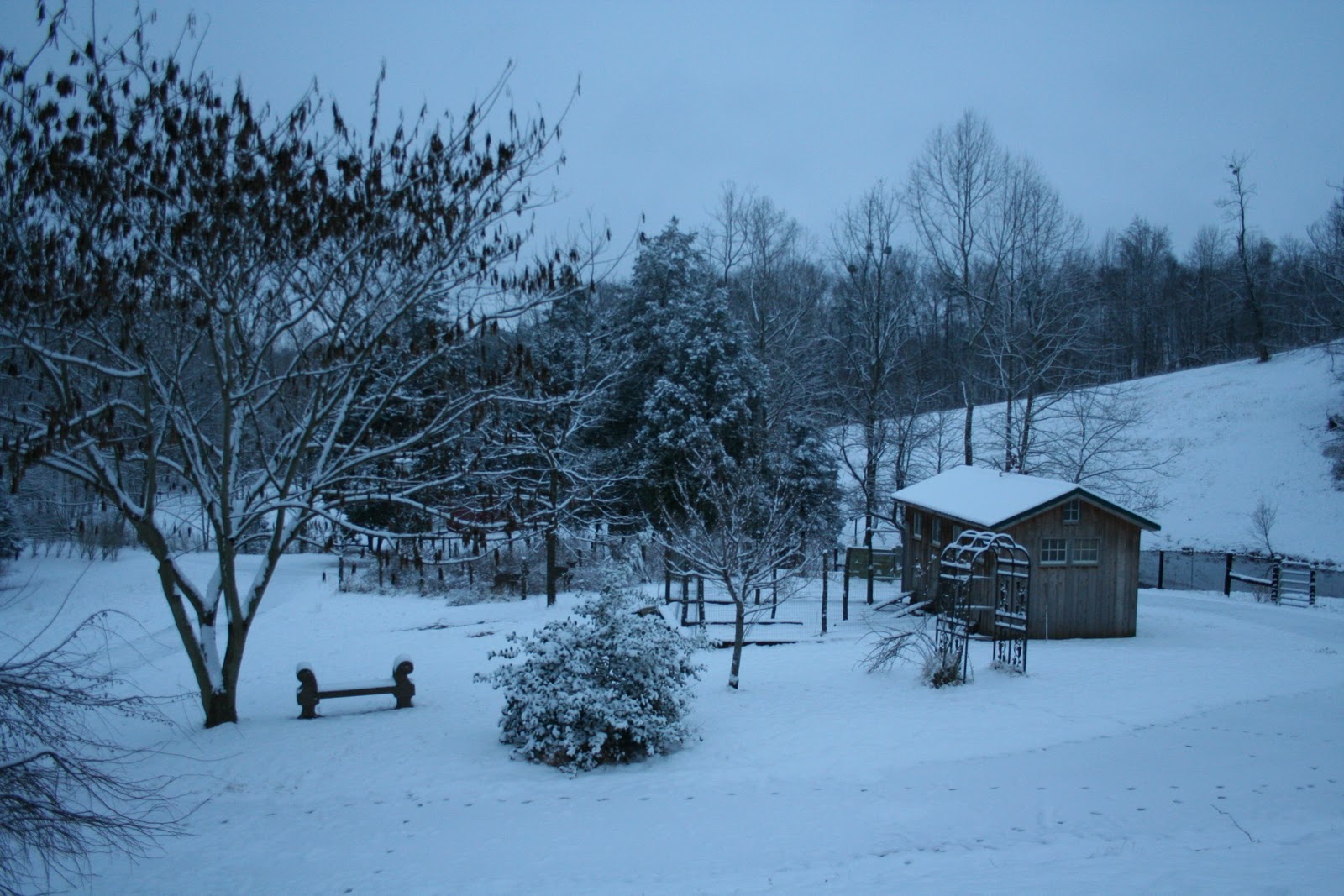
Our hen house on Christmas morning––of course we were up before dawn!
Fast forward and here we are, five years later, on a farm on a ridge in Kentucky. Now we have land spreading out so far and wide, we have stuff in storage and we live in a comfortable doublewide. We raise much of our own food or buy it from local farmers. While there is much I often think about or miss in New England, we are blessed!
My husband's birthday "Robert E. Lee" cake.
I promise that my new blog will be integrating the essence of In the Pantry that you enjoy, while also adding other "bits and pieces" of my life [thank you, Katherine Mansfield for forever imbedding that quote in my mind]. I will also still post here on occasion, especially if it is pantry-related, or The Pantry book-related. [And copies of the book are still available from my website at CatherinePond.com]
Our annual pudding of York! [Yes, that's its real color: from our own eggs!]
I am also looking forward to starting my 11-year journal tomorrow! I just ordered a 10+ Journal from Lehman's (on sale!) and it chronicles 11 years (A decade plus) in small format on one page per date (with eleven entries: one for each year's date, in five lines or less). So you can track, in Twitter-like brevity (or let's make that more like haiku-style notation, as I will never be a Twitterer!), the events of your life, day by day: or the weather, or your diet, or highlights in your family. I used to keep many extensive hand-written journals, many years ago, but this will be a short chronicle. I'm looking forward to the exercise and the meditation of it, while the blogs will continue to be my postcards to the world.
I wish you a very happy, healthy and special New Year and thank you for visiting here all of these years! I'm not going anywhere, I'm just shape-shifting a bit. Stay tuned for an announcement of the new blog in the weeks ahead.
A locally-made wooden painted turkey kit from nearby Bear Wallow Farm and a lovely pumpkin from Casey County, just a bit nibbled on by our chickens. The kit would be an easy thing to make with your children if you are crafty. (Alas, I am not.)
Here's what I love about Thanksgiving–it just extends into a nice, long weekend of leftovers and doing whatever it is that we want to do. Like hunker in on our ridge: playing games, watching old movies and family programs on television, chopping wood, general puttering around. Thanksgiving remains my favorite holiday, even though this year it was just our immediate family (minus our daughter, for the third year in a row, who works at a ski resort back in Vermont where the holidays are a blur of accommodating skiers and their families). Our boys even had an entire week off from school, which we appreciated, even though we didn't travel anywhere. [And who wants to these days?]
This little fellow has the right idea after a hearty bowl of slop.
Henry chops pumpkins for the pigs.
We were thinking of going to the Liberty Christmas parade last night, and to the Clementsville Variety Show later on today (MCed this year by our friend Joberta Wells: and check out her new blog at The Casey County News where she is a columnist–she is our local "hoot" and deservedly so, as well as having coined the phrase). We were even going to see the new Harry Potter movie (which would be Henry's second time in a week). But we're not.
A late fall bull calf, born just before Thanksgiving on our farm.
Instead, our entertainment over the past few days has consisted of moving some cattle (including some of the neighbor's that had escaped). We watched our great friend, Chuckie Willard, back in New Hampshire, and the coverage of his trebuchet-building for Science Channel's On the Road to Punkin Chunkin[on the link, click on the "Tired Iron" video]. We also watched The Fabulous Beekman Boysfirst-season marathon on Planet Green (what a joy they are, and their animals, friends and Farmer John, who lives on the premises, and we can't wait for their Christmas special on December 8–on so many levels this is a worthwhile new reality series). Oh, yes: my husband's favorite actress of all time, Marjorie Main, had several feature movies on TCM this week, too. And who can not watch the annual reshowing of The Wizard of Oz? I still cry each time that Dorothy goes home again and it is delightful to experience this movie with our own children.
A daily reminder on my mantel.
Our wine glasses!
This year our holiday mantra will continue to be "simplify." Our Thanksgiving set the tone for that: we were all clean and well-scrubbed but changed into our comfortable pajamas after feeding the animals on the farm. Our boys wanted a "Jammy Thanksgiving" and they got it. If you are not entertaining anyone but yourselves, I highly recommend it! I didn't even pull out all of the decorative stops that I usually do. And we used paper towels for napkins! (OK, so I haven't ironed in a while.)
Part of my "Country Fare" in the hutch in NH.
We did pull out our silver and paired it with our Country Fare–my favorite every day pottery, made by Zanesville Pottery from the 1940s-60s (eventually bought out by Louisville Stoneware in Kentucky). Who knew one day that I–an Ohio girl, born and bred, raised in New England–would eventually be living in the state that adopted my favorite Ohio pottery?! Those are our farmer friends Peter Sawyer and Eric Tenney in our kitchen in Hancock in early December 2007, when we had another Thanksgiving dinner all over again, but our last in New Hampshire. [Our dear bull mastiff, Lucy, is curled up for a nap: she passed away here in Kentucky almost two years ago now.]
John, Tom and Patch in January 2009. Today was their second birthday (but Patch disappeared when he was six months). This is my favorite photo of them altogether, on my favorite chair.
Our former Hancock home in a Wallace Nutting print.
Thanksgiving is time to give pause to our many blessings, the love of each other, and memories of holidays past. I'm glad that I am at a point in my life now where I can remember the magical holidays of childhood and beyond without a full immersion of bittersweet sorrow, or even a tinge of it–where I can be in a memory or a feeling or a place in my mind and linger there, a bit, but not dwell too much in what has past. It's not always an easy thing for me. ["Dwell, Stew, Obsess!" in the words of cartoonist Roz Chast.]
Edward Henry Corbould (1869), Cold
I know why the holidays can be the hardest time of year for some people: I have been in that place. I now embrace the winter months like a warm, cozy throw. It is admittedly less wintry here in Kentucky but still just as dark, cold and bleak as any mild winter we have experienced in New Hampshire. Winter is now something I am happy to put on and to wear, like a shroud, as I tuck in for a few months of reflection and repurposing. It's a necessary system reboot for the soul.
What Sting said so poetically about the winter season of darkness in his notes for his beautiful album, If On a Winter's Night, captures what I feel about winter now:
Peter Ilsted (1861-1933), Woman Reading by Candlelight
Walking amid the snows of Winter, or sitting entranced in a darkened room gazing at the firelight, usually evokes in me a mood of reflection, a mood that can be at times philosophical, at others wildly irrational; I find myself haunted by memories. For Winter is the season of ghosts; and ghosts, if they can be said to reside anywhere, reside here in this season of frosts and in these long hours of darkness. We must treat with them calmly and civilly, before the snows melt, and the cycle of the seasons begins once more.
A Footnote:
Seeing the credits roll past at the end of On the Road to Punkin Chunkin, we realized it was Chucky's tractor trailer driving out of town, east on Main Street in Hancock where we used to live in New Hampshire. But seeing it, in such a blur, we were able to stop the frames with the slow motion feature of TeVo, and there was our old house, in the top photo (at left, with the brick end). A strange encounter, indeed. The whirring of the sped up film also reminded me of how I process memory: that it flies through me in a blur and then it is gone again, like the wind. But where does it go?
Happy Thanksgiving to you and yours ~ may your blessings and gratitude be in abundance and your hearts and kitchens filled with family and friends ~ and good things to eat!
Our boys, now 13 and 10 1/2, and my husband, happy on our farm. The only thing missing is daughter Addie, working hard back in New England--we love and miss you!
We are having a PJ Thanksgiving this year: all the food and fixins and best silver (not polished in a while, however!) but in our comfortable pajamas (a good call, too, because our boys have bad chest colds). Really the opposite of what we've done for so many years and a fun change this year as we hunker in from the raw stormy weather after an eventful year and fall.
I am sorry not to have been posting regularly. If you troll through the archives at this time for the past five years you can read about Thanksgivings Past in the Pond home or search on any number of ingredients for recipes: I highly recommend Rosemary's pie dough and I'm about to make a rhubarb pie with her crust.
If you've ordered a copy of The Pantry it will be on its way to you very soon and I appreciate your patience. And, a reminder that they make wonderful holiday gifts: I am happy to inscribe them and ship them to anyone on your gift list.
As always, thank you so much for stopping by here in The Pantry and reading along with me for the past five years. There are changes to come, but all good ones.
One of the things I love about doing laundry is discovering what is in my sons' pockets. Unlike my husband, they tend to forget to empty their pockets before tossing their stuff in the laundry room (perhaps this is a learned behavior only when one does their own laundry?). Eli, in particular, is a pack rat (like his mother) and thinks nothing of cramming in his pocket a few pebbles (he is an avid rock collector) or recent fortunes from a Chinese restaurant dinner. He is also sentimental and I suppose that tweaks a few extra heart strings in me. Just as long as he doesn't become a hoarder, like his mother!
Little boys are so different than little girls. It's trite and stereotypical, but true enough.
Pebbles and pocket knives and keys to the tractor: that's what little farm boys are made of.
Our son is also an "old soul" who appreciates the the wisdom of his elders––on occasion!
Sometimes I land upright and realize, yes, that's it, it's been this way all along. Perhaps it was there all the time but I wasn't seeing and I wasn't listening. Rather than have that "ruthlessness to rest," as my great-grandmother used to write to her children (here "rest" as in "pause"), I have had a wanderlust for many months.
The Shaker hymn "Simple Gifts" speaks to this necessity to pause right where we are: "Till by turning, turning we come round right." That's exactly what I've done these past few months: whirling and twirling and now fortunate to have landed on my feet again, but glad for having had the journey.
'Tis the gift to be simple, 'tis the gift to be free,
'Tis the gift to come down where we ought to be,
And when we find ourselves in the place just right,
'Twill be in the valley of love and delight.
When true simplicity is gain'd,
To bow and to bend we shan't be asham'd,
To turn, turn will be our delight,
Till by turning, turning we come round right.
In the past six months I have been presented with several job opportunities, all from my own searching but each one, in its own way, something I feel I have been qualified to do and to do well. Problem is, I sense, with an especially tough job market now, that options are limited for writers or historians and certainly more competitive. I made the deliberate choice when my last job was downsized in 1997–– from site manager of an historic museum house to a part-time docent: I chose "I don't think so"––that it was time to have more children. We had been married not even a year and I was thirty-three, my husband forty-one. Our two boys were born within two-and-a-half years. ["The heir and the spare," as it is often referred to in jolly old primogenitured England.] I had our daughter in my mid-20s but that's another long and wonderful story.
My point is that well-educated little old me, who had worked hard at developing her career in historic preservation, public relations and freelance writing, felt it was important to be at home with her children. I had been reared in the "you can have everything you want" school: career, husband, children. But I knew better and I knew myself better than that: I have believed, for some time, that you can have everything you want, within reason, but certainly not all at the same time. If someone tells you otherwise, they are fooling themselves: their house-of-cards has to give somewhere (or they have a lot of hired help).
So I was able to be a stay-at-home mother and I hope it has served my children well (although perfectly organized, crafty and polished mother, I am not). Then we moved here several years ago, over the span of a year, and life has been busy and hectic and still not quite settled. We still have things in boxes and our real estate situation has more settling out to do yet. As my husband stretches out into the farm that we are creating, I'm often running around like some of my hens, cackling and scratching and generally in a twirl. He is project-based and linear where I am circular: he moves from A. to B. with great finesse, while I am dabbling in G., thinking about finishing A. and pondering X., Y. and Z. Occasionally I screech or peck at those around me, but I've been able to keep that to a dull roar. And, I've kept writing in some form, still selling the occasional magazine or newspaper article or copy of The Pantry from my home coffers(thank you all, for that!).
With each potential job opportunity there has been this expectation: what would the job bring in terms of challenges and income and benefits? How would it change our lives? But each job, as great it has been on paper, and as polished as I've been on paper, has not even led to an interview. This has been a bit discouraging, and also quite humbling. It has also been illuminating because I realize, finally, that I am meant to remain at home for the foreseeable future, perhaps consulting or working away from the ridge when the right opportunity may present itself, but not now. A few weeks ago when I realized this, I received a hearty check for a forthcoming article and some press-related queries on The Pantry. Around the same time I found some amazing writings from my grandmother, in an old college trunk of mine, some of which seemed to speak right to me [she was also a farm wife and a published magazine writer––and we share a focus issue, too]. The Universe was speaking to me and with a big, LOUD BANG!
So what am I going to do with all of this newly allowed "free" time, you may be asking? Well, I've given myself permission to write the stuff I want to write, to try to sell more articles and books. To blog more. To can food for winter and organize our house while we transition some more on the ridge. To be a more organized wife and mother. To start tackling a family archives project at last: for myself, for my extended family, for posterity. To walk again now that the hot summer is behind us and glorious warm fall days are here. To be more present with my family and have no regrets about what I'm not doing in the world, but to better focus on what I am doing. To be right where I am, "where I ought to be."
I've felt a bit like Dorothy in the past few months: looking for a different scenario than the one in my own back yard. Not only did I try so hard to get the right job that sometimes things backfired on me, despite my own efforts: like the time I was a "strong contender" last spring for a publications manager position, but they never received several key emails from me that would have weaned out the group to be interviewed. [I found this out two months after I first applied, when I had the guts to inquire as to what was going on: I have never had "dropped" emails before in my life, at least for something so significant!] There are other stories, some humorous, some pathetic: like when I virtually begged a headhunter (excuse me, a "Culture Catalyst"–don't ask) to convince the ad agency to let me write them some sample copy. I think that guy went running, and fast, leaving me a mere quip: "The agency is no longer in a particular urgency to hire at this time."
Finally, my own personal catalyst for this recent epiphany was this email response, when I inquired as to my status, after spending eight hours about a month ago crafting the pitch-perfect college development letter as another test of my writing abilities: "Thank you for your inquiry. We are in the interviewing stage for the position now but will bring in additional candidates as necessary. We hope to have some resolution to this search soon and will be informing all candidates of our decision."Perhaps I am reading too much into this but my gut says that, in other words: "You are way overqualified for this position (you nitwit), you will probably want a lot of money, and, most of all, you are old. And remember, don't call us, we'll call you for an interview, but only if our other younger, less qualified candidates don't pan out. As a lovely parting gift, you will eventually receive our generic 'We've filled this position but thank you and we wish you the very best in your job search' email. Now, thank you and go away."
"Ladies and Gentlemen, my name is Sally O'Malley. I'm proud to say I'm fifty years old and I like to kick, stretch, and KICK! I'm FIFTY! Fifty years old..."
I've been out of the workforce for some time. I'm graying naturally and I kind of like that. I'm definitely middle-aged but my eyes can still laugh and twinkle or be tinged with melancholy. In my heart and my head I am still that idealistic, passionate twenty-five year old young woman. So, that woman is going to be my driving force now to accomplish the things at home and with my family, and in the world via my writing, that I want to do. Let's face it: writing is an ageless profession. Many women novelists, especially those who raised a family, got their start later in life. One of my favorite books on farm life, Little Heathens, was written and published by a woman in her 80s!
Now that this midlife crisis is effectively over (unless it is just beginning), I'm going to finish my canning this weekend: salsa today, peach jam and bread & butter pickles tomorrow. Then I'm going to tackle projects: both writing and otherwise. Little bites, one life at a time. Most of all, I'm going to "write and KICK!" as my now twenty-two year old daughter has so wisely advised. Because I'm (almost) fifty: fifty years old! And time waits for no one.
One of our two new Hereford bulls in with the ladies (and some of their new calves).
I don't know what it is about Sundays lately, but I do seem a bit obsessed with them. Yesterday it was hot and humid, probably the muggiest day of the summer so far. We spent much of the day in the air-conditioned house, the boys and my husband exhausted from wrangling calves on Saturday morning to tag and give shots. [One lesson learned: wait until it's cooler to do so as the calves get even more stressed in the heat.]
A palisade on a back road in Pulaski County.
Later in the day we thought it would be fun to take a little Sunday drive. This is something we've always enjoyed, usually with a destination, but this was on some back roads we wanted to explore to the south of us, down near Lake Cumberland. Here where you reside is defined by what ridge you live on or underneath: the geography defines your community. Our farm is on the southern edge of south-central Kentucky's knob region. What this affords is a rolling, hilly landscape with deeply etched hollers carved by creeks, and higher ridges or plateaus where most people prefer to build upon. It is not as jagged as parts of eastern Kentucky, more plateau-like with finger like-ridges, bumpy hills and secret valleys. Either ridge or holler have large pastures for hay or cattle, dotted by copses of trees or wooded hillsides. It is beautiful countryside and, while it can be rough and tumble on occasion, it has a particular kind of untamed, almost untapped, wildness that we appreciate.
On our little journey, we came upon this old country store, now closed. Of course I had to jump out and take a photograph but I did spare my husband my best Eva Gabor-as-Lisa Douglas imitation. And where is Sam Drucker when you need him, any way? We would have liked a cold drink, at least.
Our boys preferred to stay home and watch a movie and, with cell phone in hand, we set off solo. It is always a chance for us to talk, one on one, and we really hadn't had this opportunity for a while without some kind of interruption (it's summer vacation, after all!). Our favorite way to "off road" is to not take a map (OK, well on longer trips we do bring a Kentucky Gazetteer for backup). As I have a built-in understanding of maps and direction sense, and only usually need to look at a map once or twice to absorb its spatial relationships (yes, this is an idiot savant skill I seem to have been born with), my husband has learned to trust this about me. Doing this kind of "off-roading" (or off-mapping?) is not being afraid of making the wrong turn or the thrill of the wonderment of where we might come out. I rather live my life this way, too: taking many roads and exploring new ones around the constant fixture and presence of home and family. And, as long as I can catch a glimpse of our little "monadnock" here, Green River Knob, I always know where we are.
Green River Knob rises to the west of our own knob pasture on our ridge. It is not only the highest knob in the region but the highest point in Kentucky west of its eastern mountains. The Kentucky knobs, I've realized, are very much the last western gasp of the Appalachian mountain range that forms a long spine up to the northeast.
This same phenomena occurred when we lived back in the Monadnock region of New Hampshire, too, as wherever you go, or soon nearby, you can see the great mass of Mount Monadnock as both a presence and beacon. These geographical fixtures define our places and provide an odd kind of security, too. When we are on top of our knob looking out and I see Green River Knob watching over us to the west, I always find it rather comforting. There is wisdom, truth and solace in the hills around us.
At dusk there was an odd, brilliant light from the east that cast itself on the lawn in an eerie glow. We soon realized this was created by the reflection of the setting sun on the edge of a large thunderstorm system which went around us to the south. A perfect night for a "Thunder Moon."
The chicken house at dusk, just after they'd gone into roost.
So we drove along seeing old homeplaces, new roads and different pastures and felt refreshed by the drive, the company and the air-conditioned car. To take a drive like this, whether for an hour or for the day, is always like a mini-vacation not too far from your own backyard. We came home to a build-up of thunderheads that didn't rain on us, unfortunately (it was the full "Thunder Moon" last night) and shucked some fresh corn a neighbor had given us. That, with some grilled chicken breast, was supper. Ah, a summer Sunday, to paraphrase Henry James, two of the most lovely words in the English language.
In recent years our table has been a "groaning board" of good friends, our immediate family and beloved kin who "enter and pass among us in living love and in memory." As one of my friends likes to say, "as we get older, we make our own family."
Yesterday, a quote I posted by Wendell Berry on "pacifist chickens" led to all sorts of other great quotes over on Facebook. One of my favorite readers of this blog (and a local friend on Facebook and in person, even though we have met only a handful of times) shared a favorite quote with me. It turns out it is an entire poem from Berry's Leavings collection. If you have never read Wendell Berry in any genre, you can't go wrong with anything he writes: he is one of our finest environmental essayists, poets and novelists and he happens to live and farm here in Kentucky where he was born and raised. His essays have always been ahead of their time and they speak of sustainability, the dangers of living outside of our means, of the beauty and power of simplicity and honoring our land. He is like a humble sage of our time, quite unknown by those who should know of him, beloved by those who do.
Wendell Berry–a man of letters and the land.
The owner of an independent bookstore group, Willard Williams of The Toadstool back in New Hampshire, said he always judges a bookstore by its inclusion of Wendell Berry in the poetry, novel, philosophy, environment and essay sections. When I read this poem today it reminded me of my "Sunday Dinners" blog post, below, and the poem that inspired it, the other day. It is also of note that Berry composed the poems in Leavings on a series of Sabbaths over the course of several years. The Sabbath is something we are trying to better honor in our family, returning it to what it should be: a completely suspended day of only essential work but more importantly, to have fellowship with our family, friends and our spiritual selves. To find the quiet within the center of who we are or the place around us and then to carry that into the rest of our week. There is just too much pace and not enough pause in our world any more.
Not having read Leavings, I can only assume that the poems are, as this one is, the best kind of prayer or spiritual moment, perhaps Berry's own benedictions:
VIII.
I tremble with gratitude
for my children and their children
who take pleasure in one another.
At our dinners together, the dead
enter and pass among us
in living love and in memory.
Ham awaits preparation at a Sunday dinner we had with our Shaker friends in Sabbathday Lake, Maine.
"Sunday Dinner" by Dan Masterson, is a pleasant conjurer of so many things for me: family gatherings, good food, communion, fellowship. [I highly recommend the daily poem in your email via Garrison Keillor's "The Writer's Almanac."] We used to entertain a lot more in New Hampshire, sometimes to the level that the poem describes (remember that my pantries had stuff in them that needed to be used once in a while!). But what it reminds me of most is the family dinners we used to have at my grandparents' Ohio house where we gathered together with my grandparents at the helm (who were raised during the last gasps of Victorian formality), their two children (my dad and his sister), their two spouses (my uncle and mother) and we six grandchildren (all cousins and siblings). We didn't get together on Sundays in any formal way but about once a month we would gather for either a birthday or a holiday dinner, or some combination of the two. My grandmother, if anything, was a great matriarch that way. Now we are deceased or scattered across the lower-48, as so many families are today, rather helm-less at times.
In New Hampshire, on my grandparents' farm (on my mother's side of the family), my grandmother would frequently roast one of their chickens for Sunday dinner after church–or just because–and serve it with vegetables and new potatoes from the garden. We would drive over to Silver Ranch (now Kimball Farms) for homemade ice cream for dessert. While the farm was a less formal environment, it was just as filled with that family sense of gathering and purpose, of old and repeated stories, of new thoughts and ideas, or laughter and foot nudges under the table. The last family gathering we had there was at Thanksgiving in 2003 when my mother brought us altogether for the last time. Now it seems like a pleasant dream from another lifetime.
Thanksgiving dinner in New Hampshire.
The poem "Sunday Dinner," which really seems like more of a winter or autumn poem to me, is about the formal trappings of gathering and ritual, even though it does not mention a person in it. Family and fellowship is only implied. A reminder of the Victorian age when the sideboard was a kind of gastronomic altar of abundance and plenty, the poem also evokes a simple Sunday dinner, too. You could say that this poem is just about food, inanimate objects and their presentation. When I read it, I also think about who might have cooked the food, how it was presented, what was the feeling behind it, who may have served it, and who were those who gathered to eat it. I think of the communal nourishment that is the essential part of so many gatherings of family or friends.
In some way, every family has had a Sunday dinner on occasion. I want to strive to make it more of a routine again in our household and not just for holidays. I hope that I am a matriarch-in-training for my children, and perhaps grandchildren, one day. I do believe, from both observation and experience, that every family needs a loving but declarative, no-nonsense but objective, matriarch or patriarch (or both) at its helm to be successful as a unit. Otherwise we can feel rather adrift and rudderless. And because there is nothing like a mother ship in a weary world.
Sunday Dinner
Linen napkins, spotless from the wash starched
And ironed, smelling like altar cloths. Olives
And radishes wet in cut glass, a steaming gravy bowl
Attached to its platter, an iridescent pitcher cold
With milk, the cream stirred in moments before.
The serving fork, black bones at the handle, capped
In steel, tines sharp as hatpins. Stuffed celery,
Cut in bite-sized bits, tomato juice flecked
With pepper, the vinegar cruet full to the stopper
Catching light from the chandelier.
Once-a-week corduroyed plates with yellow trim,
A huge mound of potatoes mashed and swirled.
Buttered corn, side salads topped with sliced tomatoes,
A tall stack of bread, a quarter-pound of butter
Warmed by its side. And chicken, falling off the bone:
Crisp skin baked sweet with ten-minute bastings.
Homemade pies, chocolate mints and puddings,
Coffee and graceful glasses of water, chipped ice
Clinking the rims.
Cashews in a silver scoop, the centerpiece a milkglass
Compote with caved-in sides, laced and hung
With grapes, apples, and oranges for the taking.
Greetings and salutations to everyone here in the pantry! I just wanted to chime in, briefly, during a very busy season to say that I'm still here but not so much on the computer these days. Our daughter visited for two lovely weeks this month, between resort seasons, and we've been doing our first cut of hay on many acres (and our first time doing our own hay). I've realized it is not only a busy and complicated process, especially around the weather, but I'm often getting a hearty noon meal for a hungry group of men––and supper, too. And the laundry: don't get me started! [But it is so worth it just to see both of our boys driving around farm equipment and moving large round bales across our fields like seasoned farmers! What better way to spend their long summer vacation which started in mid-May?] As for our house, well, let's just say it needs a major fix of something. [And the power head on our vacuum is broken...truly, it is!]
Picnics on the west porch at Ida's
are de rigueur this summer.
Fortunately, I've been able to cater farm meals out of the kitchen in the house that we've decided to fix up to live in––across the road from us at Ida's farm. This has been a blessing to me this summer: the more commodious kitchen, the wide west porch outfitted with our old and sturdy picnic table (from my great-grandmother's picnics of long ago––in fact, it had not even been used since Ohio barbecue days in the backyard). We will retrofit the house this fall and winter to my hatching plans: simple but workable.
Our daugher Addie with her Momma.
While our daughter was staying there, and as we used it to cater our second "frolic" (for a hay shed-raising), it has provided me with a major architectural epiphany. There is also a great feeling to the place and that aura––as well as the cooling breezes even on the hottest days (the house actually stays quite cool on its own)––is important to me and to all of us. I also like to be at the center of things at the farm rather than cooped up in this bread box of a doublewide in the woods across the street. I know Ida would approve of this plan.
Local Kentucky strawberries are so worth waiting for each spring.
Henry, 12 1/2, has become an expert tractor driver and young man-about-the-farm.
My husband Temple–out standing in his field.
I've also been rethinking blog life in general. I do want to continue "In the Pantry," and will, but I'm also developing another blog at this time that will be more current with my life now––even though pantries and food and family and home are always a part of this great life. Stay tuned for more on this and an official launch date sometime this summer. In the meantime, I am writing and working on some new projects and I do find that blogging and writing for publication can not always intermingle effectively at the same time.
South Fork Creek Road on Monday morning, after the historic flood of May 2nd.
When we saw the road on Sunday evening, at almost peak, it was impassable
and the water had risen to the top of the signs at right.
In my freshman year of high school, one of my best teachers along the way, Anne Sirois Pelletier had us memorize Portia's courtroom speech in The Merchant of Venice by William Shakespeare.
It begins:
"The quality of mercy is not strained. It droppeth as the gentle rain from heaven Upon the place beneath. It is twice blest– It blesseth him that gives and him that takes."
I thought of this passage over the weekend as we got record-breaking rain in many parts of the South. I'd been praying for some rain for weeks–selfishly because of the awful tree pollen this year but also for all farmers and gardeners who rely on the rain to make things lush or to fill water tables. The irony is, of course, that in Shakespearean English "strained" actually means forced–so mercy, according to Portia, should not be so. It should be gentle and for all, no matter whom. However, as Ralph Waldo Emerson once said, "The good rain, like the bad preacher, does not know when to leave off." [Yet Mark Twain also noted, "Water, taken in moderation, cannot hurt any body."]
We were blessed to get the rain we needed on our ridge and that it didn't destroy anything, except to carve a few unwanted channels in newly seeded areas. [And I did discover, just today because I happened to be listening to a local radio station, that the roads on our ridge are on a boil order–no idea why and it would have been nice if they'd called us!] Other parts of the region were not so fortunate. The Highway 127 bypass around Liberty was flooded from Green River (it is located on a flood plain but no one has seen this kind of flooding in years) and many businesses were affected. Historic Penn's Store, which I have often visited and blogged about, located in northern Casey County, has also announced that due to flooding, they will be closed indefinitely. There were only a few flood-related deaths in the state but many homes and bridges were damaged or destroyed in low-lying areas.
On Sunday night we drove down to our creek farm. It is only a mile away but the passage from our home on this ridge can be treacherous even in good weather. So we went the nine or so miles around over to the next ridge and down, with occasional moments along the way of crossing water on the roads, even on high ground. I have never seen our creek so fast and furious. We could barely speak over the rushing water and the entire creek bed was full of it, some twenty five feet across and easily five feet high in places, with still higher rapids. Where the branch ran into the larger creek–and where we can normally cross the ford in drier weather and lower water–there was another rush of broiling, angry murk. Filled with sticks and logs and other debris, it was not safe to near it and yet, as at the side of Niagara Falls where it goes "over the drink," as my father used to say, there is this strange pull towards its sheer force and powerful beauty.
Not long after we arrived, with my husband and sons further down the bank, I watched as a good-sized black walnut tree dislodged itself from the banking. It was as if a giant had just pushed it out, as we humans might pull a willing weed. It was soon heading downstream and I hollered at them to watch out. By the time it rounded the bend at the ford and joined the larger creek, it had been stripped of all of its limbs. It all seemed to happen slowly and deliberately, as if in a dream.
Next we headed back up the ridge and over to South Fork Creek–or what we like to call the Mennonite valley–to see what was happening there and to check on some friends. We entered the back way on higher ground and soon realized as we came down into the creek area, near several stores like Sunny Valley, that we would not be able to pass. The water had flooded the banks into the fields and over the roads in many places, some two or three feet. When we came down a hill towards another state road we looked out towards Highway 127, about seven miles south of Liberty. All of the pastures in the Green River valley were an ocean of brown water with small islands of trees here and there. I'd never seen anything like this before except in a disaster movie.
We met people we knew on the road and many friends, out looking like we were, and learned that school would be canceled in the county the next day. We were certain that the boys' school would be, also, as there would be few, if any, ways to reach it on the ridge where it is located above South Fork Creek. We also learned that the Highway 127 bypass near downtown Liberty, the Casey County seat, had been closed because of excessive flooding of the businesses and residences along the way. As it began to get dark, and with fewer options home, we headed back over high ground to our farm on the other side of the Casey County line.
Two empty oil tanks floated up from beneath the pavement on Hwy 127.
We frequent many businesses in this section of town and 80% were affected.
The volleyball nets in Gateway Park in Liberty captured river debris as it passed–but the force of water was not strong enough to move the Army tank.
For some reason, I forgot to bring my camera the night of the flooding. I'm realizing it is OK to experience life without one sometimes, but this would have been one of those occasions, and unfortunate historic events, where it might have been a good idea. The next morning we did go out again, to a glorious sunny day, and saw that the flood had receded but the damage was done. Maybe this is what Noah and the people and animals on his ark may have felt after the flood as they watched the blue skies and white clouds and perhaps felt the sorrow of an Earth changed but cleansed.
One of our sons asked, "Where did all that water go?" Where, indeed. It is my understanding that the area's rich and abundant bottom lands and quiet hollers were once the bottom of an ocean. The salt water receded and fresh water from the eventual glacier melts carved the long-fingered ridges that form our knob region. It was not hard to see on Sunday night how water carved these hills and creeks and ridges and occasional palisades that form south-central Kentucky's beautiful and rugged landscape. By Monday morning, less than twelve hours after their height, the waters had receded again back into the Earth.
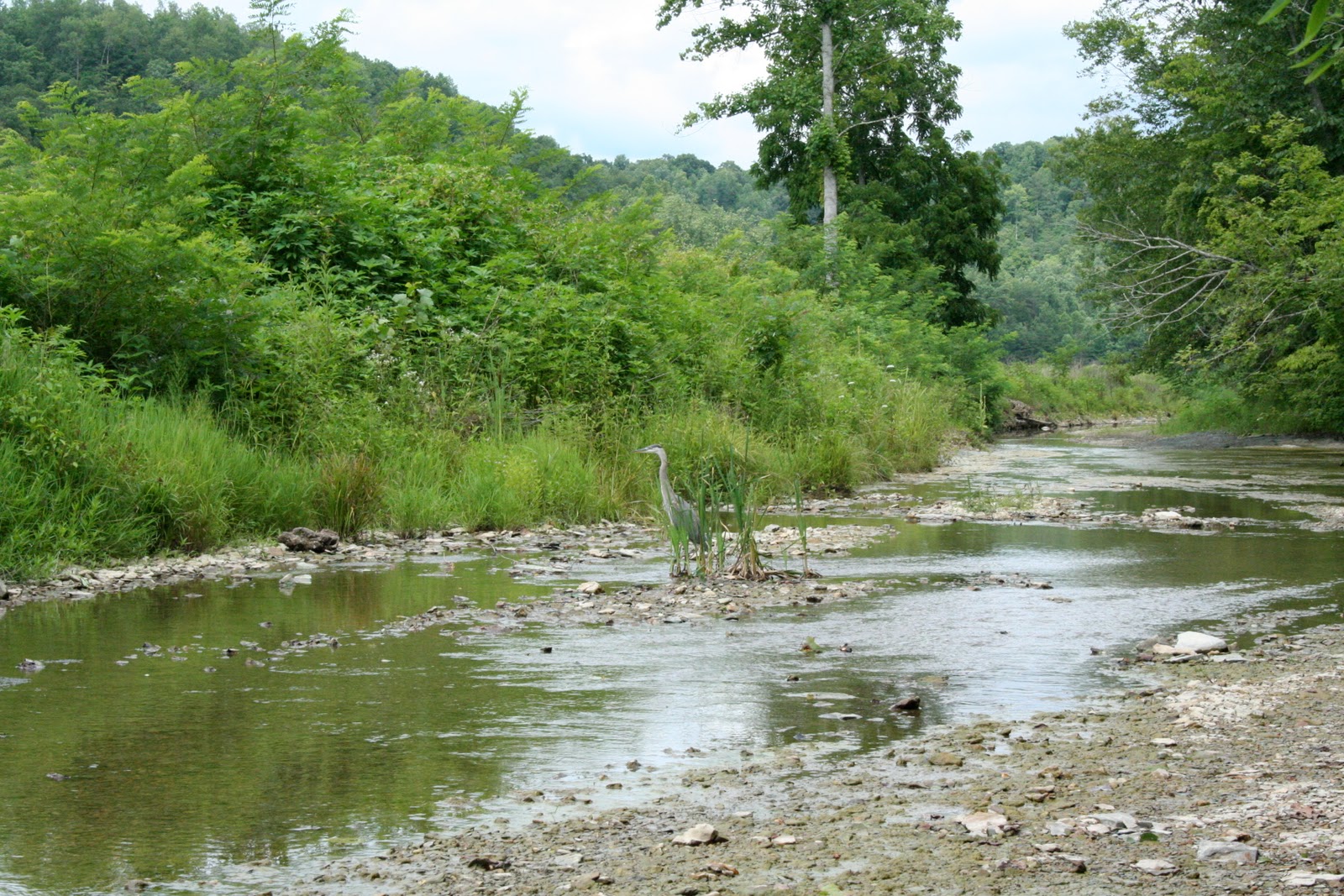
Our creek in quieter times–note the Great Blue Heron on the little island.
There is a passage in the novel A River Runs Through It by Norman Maclean that describes the interconnectedness that we share with water. We humans are mostly water, of course, and we need it to function and to live, like all life forms. But there are times that we need its mercy, too.
"Eventually, all things merge into one, and a river runs through it. The river was cut by the world's great flood and runs over rocks from the basement of time. On some of the rocks are timeless raindrops. Under the rocks are the words, and some of the words are theirs. I am haunted by waters."
~ Norman Maclean, A River Runs Through It
I have a new respect for the power of water and how it can be a mere drop, or a gentle rain or a raging torrent from the heavens. It is an element, like all of the others, that must be respected. And I now better understand an oft said Appalachian expression, "The good Lord willing, and the creek don't rise."
+ + +
Last Friday we attended the local Mennonite community's first Haitian Relief Auction. It was a pleasure to buy a locally-made picnic table and benches, a much-needed garden cart, some new baking dishes, as well as delicious barbecued chicken dinners, fruits, vegetables, pie and other baked goods and to know that 100% of our money will go to Haiti through Christian Aid Ministries. I was disappointed that more in the local community did not attend beyond the local Mennonites and Amish, who also came from other states to be there and bid on items they could easily have made themselves (many fine quilts, for example). But it was the first such auction held by the local Mennonite community, it was held on a Friday and next year will be on Saturday, April 30th. I'm sure there will be more people attending next year.
Sometimes misfortune hits closer to home, too, as in a flood of this kind of proportion and devastation. In the coming months there will no doubt be more relief efforts for local families and businesses in need. Our thoughts and prayers go out to those who have suffered from the devastation of the flood waters. Many of those affected live below the poverty line and have no insurance. If you would like to help those in Casey County who have been hard hit–both residents and businesses alike–you can give through a fund set up through the Liberty-Casey County Chamber of Commerce. For more news and photos on the flooding and its aftermath, you can follow coverage at The Casey County News.
Also, If you buy a copy of The Pantry this month, I will happily sell it to you for a reduced rate of $12, including postage, and donate $5 from every book sold to the Liberty and Casey County Disaster Relief. Email me at info@CatherinePond.com and I will bill you directly via PayPal or you may send me a check. If you've already ordered a copy of The Pantry since May 1st, I will also donate $5 from each copy sold.
Please spread the word! I will sign and send your book to you or your mother, a teacher, sister, friend, or anyone who loves pantries and old kitchens and the security and comfort that they provide.