The Horace Walpole Library belonging to Wilmarth Sheldon Lewis, taken by Life Magazine in 1944 at Lewis' home in Farmington, Connecticut. The library as an institution, and as a place in our schools, communities and even our homes, has been on my mind in the past few weeks. Are you as drawn to what books people have on their shelves as I am? Or what they might have piled high from their local library? Or if a person has any books around at all? (I know, I'm just a nosy old poke.)
 I have been in several public libraries this summer, have reminisced about more, and even have a few librarian
Facebook "Friends" and blog readers (and some are also real live friends). So I have had a blog brewing on the subject and this evening the following came in via a
Facebook posting by a New Hampshire town librarian. It seems that
the library at Cushing Academy in Ashburnham, Massachusetts is getting rid of its books.
In this age where print is threatened by the Internet (
OK, I'm a blogger but I still read books, magazines and newspapers, and sometimes even write for them, too) and awful
gadgety things like Amazon's Kindle (sorry Oprah, but I ain't buying it), the medium of the printed book is even more precious. I have often blogged about book shop finds here at
In the Pantry and at
Cupcake Chronicles where two friends and I continue to write about the books that we read apart or together. You can't escape the tactile feeling of a book in hand. My eyes might be morphing into a need for driving glasses
and reading glasses and no, not willing to concede to
bifocals just yet, so how is reading a book on a flickering computer screen good for anyone? The children at
Cushing Academy, as all children and adults,
need books: bindings to crack, pages to flip, and dusty tomes to dig out of old archives and catacombs.
 Andrew Carnegie
 established a grant program for American libraries in the earlier part of the 20
th century, donating more than $40 million between 1886 and 1919 to construct 1,679 new libraries in the United States and about $56 million for libraries worldwide. In one of the greatest philanthropic gestures in our nation's history, we have this Scottish-born American industrialist to thank for much of the great library architecture and collections that remain today.
[Image of Andrew Carnegie © Columbia University Library]The first library I ever visited was the Ayers branch of the
Akron-Summit County Library in Akron, Ohio. We lived almost around the corner but drove anyway because the traffic wasn't conducive for my mother to walk with a stroller and three children. The library branch was housed in a large former home on Market Street, in the Tudor Revival style from the 1920s as so many suburban homes of that era were, with a 1950s addition on the back. It was brick and kind of Gothic-y. Inside were shelves of books and cozy corners. We went there often and I was always able to check out an entire pile of picture books. I can still hear the magical and tidy "ka-chunk" sound of the lever pressed on top of the plastic library card through the paper and carbon and well remember the satisfaction of having my own library books to take home. Problem was that I wanted to keep many of those books–even to jump right into many of them–and it was often hard to return them (not for my punctual mother but for her hoarding daughter who liked to linger). I was sad to see a few years ago, like so many buildings in Akron over the years, that the original house-turned-library was torn down (and yes, to make a parking lot for another building). The newer, larger branch is on another street nearby.
I've been to the downtown branch of the Akron-Summit County Library over the years, but not since its latest transformation. The 1970s library was constructed in the unfriendly and cold "
Brutalist" style of architecture inside and out, that filled so many urban vacuums at the time and was laden with modern art and hanging mobiles. I didn't find it very welcoming, just like the newer main branch of the
Boston Public Library, but that's just me: I like cushy and cozy in a library.

Meanwhile, the library of my great-grandparents Akron home, now a
museum (since 1957), is so inviting that even Helen Keller remarked that it was her favorite room in the house as she could feel its presence. Even though I never knew him, I've always liked seeing the charred wood on the library shelf where my great-grandfather used to rest his cigar. It was also here, on a 1970 tour with my Grandpa with my second grade class, that I first heard of Helen Keller. I became a girl obsessed: a woman who is deaf, blind and mute and could learn to
read? I was soon reading all I could about this remarkable woman. How would she manage in a virtual library such as
Cushing proposes? Can a deaf and blind person "read" a computer?
PHOTO: Helen Keller wrote on her photograph on December 21, 1924, "In witness of three beautiful days spent at Stan Hywet Hall and my sincere affection." [Image © Stan Hywet Hall & Gardens, Akron, Ohio and used with permission.]

On summer visits to the Gray Goose Farm to see my grandparents in New Hampshire, I spent long afternoons reading the
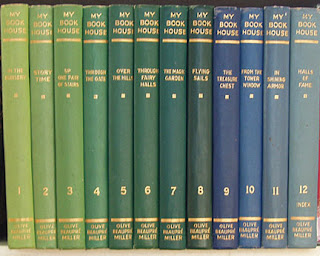
"My Bookhouse" series that my grandparents had in their extensive multi-generational library, scattered about in bookshelves but especially gathered in what was called "The Toy Room," the southwest parlor at the front of their 1792 farmhouse. [I later bought an entire set at a used bookshop for my children–the same edition as theirs (for $10 each in those days)–and several years ago bought an earlier set still in its original wooden "Book House" from a woman in Connecticut who also collects Country Fare pottery. She gave me an amazing deal on a "Book House" with books because she knew I would treasure it.] I also looked forward to going to the
Jaffrey Public Library with my grandmother where I could wander around and check out different books (often cookbooks and where I discovered
The Buttr'y Shelf Cookbook for the first time).
PHOTO: The Toy Room, Gray Goose Farm, Jaffrey, New Hampshire, summer 2006.
During my high school years in Jaffrey, I often went to the town library after school where I always enjoyed talking with librarians Miss Margaret Priest, an Englishwoman, and Miss Gwyneth Andrews, from Scotland. They also gave the library a natural air of calm and repose and you just wanted to have a nice cup of tea and some scones with them. I last saw Margaret in 2005 when she joined us in Hancock for our Thanksgiving dinner. Margaret was also a dear friend of my friend and children's author
Elizabeth Yates McGreal and lived next door to her in "Pineapple Cottage" on Old Street Road in Peterborough for many years.
PHOTO: Margaret Priest, Thanksgiving 2005, Hancock, New Hampshire.
One of my relatives by marriage,
Wilmarth S. Lewis (don't you love that name?), was a Horace Walpole scholar and collector and had a rare book library that he amassed in Connecticut; it was later donated to Yale University where, since 1970, it has been the
Lewis Walpole Library. He gave an old 18
th century leather volume, an English hunter's companion if memory serves, as a wedding present to my parents (and my mother was able to sell it at a rare book auction years later). I never met Cousin "Lefty" (I was told my manners had to improve significantly before that could happen–something that was always held in front of me like an elusive gem) but I expect we would have had a lot to talk about, especially years later when I wrote part of my college thesis on Walpole's writings and his vision of Gothic Revival architecture.
PHOTO: Annie Burr Auchincloss and her scholarly husband Wilmarth S. Lewis, aka "Cousin Lefty" in the family. [Image © Yale University Library] That's me on the right in my 3rd grade yearbook photo in the Lower School library of Old Trail School in Bath, Ohio, c. 1970. Three of us in this photo, as well as other would-be high school classmates, have recently connected via Facebook. Most of us left in middle school but are now trying to arrange a 30th reunion for 2010.
I always enjoyed library time at various schools over the years–and really got into the Dewey
Decimal system in Library Science in 5
th grade at
Old Trail School. In the Lower School library I had discovered the delights of Betty MacDonald's
Mrs. PiggleWiggle series as well as children's books by Roald Dahl and
The Lonely Doll series of live-action photography books by Dare Wright. The Laura Ingalls Wilder books were also favorites. I later worked for the
Wheaton College Library (Norton, Massachusetts) throughout my years there. In the fall of my freshman year, the new library wing and its subterranean stacks were christened. I spent many days and evenings in "the stacks" in favorite study carrels, tucked away where time just seemed suspended and in a way that seemed more productive than the hours that seem to be sucked into the computer today. When working I got to put the books away according to a new system for me: the
Library of Congress classification (and for some time one of my longest friends from childhood has worked at the
LOC). As I remind my children, much to their disbelief, I had an electric typewriter in college, no cell phone, and used a card catalog to find books on the shelves. Furthermore, that was only 25-30 years ago. So in the span of thirty years, the idea of going from a library with real books to a virtual "learning center" with a
cappuccino café at
Cushing Academy in Massachusetts is, well, preposterous. Call me sentimental.
 The Radcliffe Camera at the Bodleian Library, Oxford, England © National Geographic
 On two academic trips to England–one for a high school semester and another full year in London–I really got to immerse myself in the full library experience both at
Bodleian Library in Oxford (so now you can understand why, despite it's tragic overtones, that I love Thomas Hardy's
Jude the Obscure) and at the
University of London library system. I also researched at the
National Art Library at the Victoria and Albert Museum and other smaller libraries around London. In 1982 I had my first college internship cataloging a donated postcard collection at the library of the
National Trust for Historic Preservation, then headquartered in Washington, DC but now a part of the University of Maryland.

During my years in Boston in the mid-1980s I was a regular at the
Boston Public Library and in their archives and had a special student pass to the
Boston Athenaeum (which, if pressed, is probably one of my very favorite private library experiences–we are proprietors there, too, but never have been able to get down in the past decade or so). In fact, it amazes me to sit here recounting all of my collective library experiences because, with Google and many digital collections at my finger tips, it just seems such an archaic thing to be doing: digging around old books and files for research. However, please don't misunderstand: while Google fills a need and a void made real by time, place and circumstance, I would gladly roll around and encamp in a research library again for extended periods of time. In recent years I have used the
on-line LOC collections for research for
The Pantry, as well as the fabulous
HEARTH [Home Economics Archive: Research, Tradition, History] archive at Cornell and other on-line digital collections. Their ease of access, free use and savings on travel and time has been invaluable and their search mechanisms time-saving. However, I would never want to banish books from a library collection entirely.
IMAGE: The Boston Athenaeum was designed by architect Edward Clarke Cabot who also designed the Gibson House, built in 1860 and a house museum since 1957 and where I lived as resident guide in the mid-1980s.
For the first twelve years of our marriage, until we moved to rural Kentucky, we lived next door to the
Hancock Town Library. Did I visit it much? Surprisingly no, but this was because we had a tremendous library in our own home, now mostly in boxes, and I didn't have as much leisure time to take books out and read them back then (let alone return them on time–yes, even from next door!). Our children and Aunt Cynthia were regulars, however, and it was so nice to have them all be able to go back and forth with ease. Meanwhile, our house library was a multi-generational collection and added to with our own interests and subjects, including many children's books. It was sad to dismantle it but most came along with us and the rest was donated to various friends and other library sales or book dealers. One thing I have noticed about small-town libraries is that the "shush" factor no longer seems to exist. They have become, in many ways, the new general stores of a town–the place to meet and greet, exchange news and well, gossip (but, ssh, you didn't hear that from me...).
PHOTO: The Hancock Town Library is at the center of the picturesque New England village of Hancock, New Hampshire, a town, interestingly enough, that also has many resident published writers and others who are in the book business. [I wonder if it is the water, the town's charm or the clear air?]
So I haven't found small town libraries to be conducive for studying or reading in recent years but that isn't to diminish all of the great resources, terrific programs and "Friends of the Library" groups, and enterprising, dedicated librarians that they offer. Besides, Hancock's current librarian, Amy Markus, dared the town's children that if they read a certain number of books this summer, over 700, she would dye her hair pink. How cool is that? (And yes, the children read 729 books and her hair is now pink!)
PHOTO: Beaming librarian Amy Markus is also probably wondering, "How long will I have pink hair?" Read more about Amy's transformation here.
Here in Kentucky we have county libraries, some with several branches. A few weeks ago, our boys and I had some time to wait while in Liberty, and decided to pop into the
Casey County Library to finish some homework after school. Kathy Goode is a welcoming librarian and friendly, outgoing person and fun to talk with. [She was just back from an enviable trip to England and a library course there.] I was grateful that she offered us the back meeting room where it was quieter and perfect for a quick homework session (and where we wouldn't disturb anyone else). Afterwards, in some limited shelf browsing, I was pleased to discover a memoir by Shirley Jackson called
Raising Demons that is a sequel to her
Life Among the Savages, one of my favorite memoirs about family life. It is still in print but I took out the first edition pictured here with it's lovely jacket illustration–I had no idea of its existence before. It is now on my nightstand, partially read, and I'm going to have to soon part with it. This might be why I have so many books of my own (and many purchased at used bookshops and "Friends of the Library" book sales over the years): parting is such sweet sorrow and they look so nice on my shelves. I feel secure with a book in hand and nearby in some kind of order (and yes, I've even organized my own books over the years).
 PHOTOS: Shirley Jackson was perhaps best known for her chilling short story, "The Lottery" and was a master of modern Gothic fiction. She lived with her husband and four children in Bennington, Vermont throughout the 1950s and until her untimely death in 1965 at the age of 49.
Somerset has a brand new brick main branch of the
Pulaski County Public Library which houses the Historical Society, a beautiful children's room, and other rooms for meetings and community use. The main reading room is like something out of a modern English refectory with its steel vaulted beams and a hint of Harry Potter in the stacks, complete with nice cushy seats by a northern window with constant light...and
WiFi. I am contemplating a portable winter office there. I might not take out many books but I'll put my feet up with my laptop, catch up on some newspapers and magazines, and write. There is nothing like a quiet library away from one's familiar–and laundry and too many to-do lists–for a needed getaway and focus.

Finally, what prompted this (rather long) library blog was a recent email I received from a blog reader ("the Library Lady") at the
Emily Taber Public Library in
Macclenny, Florida. She kindly wanted me to know that my book,
The Pantry, resides in this building and has been checked out many times. That is always good news to a writer. She also writes that they are presently building an addition on the back of the older structure. That's always good news, too: combining the new and updated with the old, historic architectural fabric.
PHOTO: The Emily Taber Public Library, courtesy of a blog reader. Don't you love the juxtaposition of the palm trees next to a Greek Revival brick building?There is a rather over-the-top disaster movie called
The Day After Tomorrow that came out a few years ago. After several catastrophic global storms, New York City is besieged by extreme and life-threatening subarctic temperatures. A number of survivors hunker into a reading room in the
New York Public Library and start burning books for fuel. This is understandable, given the circumstances, but it is a reminder of the deliberate book-burning episodes in different sad chapters of our country's history (as well as Nazi Germany, to name a few). It also points to what is left when a world culture or society collapses or dies away: artifacts and books or other writings.

Despite our technology, which always seems to have to be improved upon and too quickly becomes obsolete, the essence of a book hasn't changed much throughout history, only in how it is printed and distributed. It remains an extension of ourselves or a window on another time or place. You can pat it lovingly into a shelf, put it next to you on your nightstand, or bring it along in your handbag. [However, that said, a digital archive of collections and photographs is also useful for internet researchers as well as providing a needed back up copy in case of fire or other disaster–such as the ghost rampage at the New York Public Library in the first
Ghostbusters movie–remember the card files and books flying everywhere? And that librarian ghost knew how to say "
SSSSSHH!"]

The motto over the older Wheaton College Library entrance states: "That They May Have Life and Have it Abundantly" which was paraphrased from what Jesus said in John 10:10 [And I didn't go to the Christian college in Illinois by the same name, but to the former women's college, co-ed since 1985, in Massachussetts.] I suppose, twenty-five years after graduating, I have done just that. I have also realized, or remembered, that my college library was designed by the same architect,
Ralph Adams Cram, who designed the Norman-style church,
All Saints' Episcopal Church in Peterborough, New Hampshire, that over decades held so many events in the life of my immediate and extended family: marriages, memorial services, christenings, confirmations. No wonder I had such affinity for both places! A library–and the world of a book–opens so many doors into our inner and outer worlds, whether you are able to attend college or not. So in this post-Labor Day back-to-school time, here's to cracking a lot of good books–metaphorically speaking, of course!
PHOTO: An image from the Wheaton College archives of a Greek tragedy played out in front of the newly-constructed library in the 1920s.
POSTSCRIPT ~ Tonight, when researching (yes, via Google), I came across this:
 "Books constitute capital. A library book lasts as long as a house, for hundreds of years. It is not, then, an article of mere consumption but fairly of capital, and often in the case of professional men, setting out in life, it is their only capital."
~ Thomas Jefferson
PHOTO Library at Monticello, also known as the Book Room © Thomas Jefferson Foundation/Robert C. Lautman.