Sunday, July 22, 2007

North End Market Tour

Polcari's Coffee in Boston's North End has all manner of ingredients––and coffee, of course––packed into a corner store.


A month ago, just a day after the summer solstice (and having put my two boys and husband on a plane to Colorado), my friends Linda and Rosemary and I went to Boston for a North End Market Tour. A three-hour guided tour, we ventured through seven small Italian markets on a cool and breezy summer day, with the odd passing shower. [For more on these excellent tours, organized by Michele Topor, see: www.NorthEndMarketTours.com]
Boston's North End is primarily an Italian-American neighborhood.
My brothers used to live in the North End at different times in the 1980s and 90s but I, like so many tourists, even though I lived in another Boston neighborhood, didn't really get to know the heart of this diverse part of Boston culture and cuisine. Had I been more of a cook back then, I probably would have ventured there more regularly. The landscape has changed now because of the "Big Dig" which has buried Route 93, formerly an elevated series of lanes and exits right through the city of Boston.
Shops like Maria's Pastry Shop now see the light of day after the "Big Dig" (a ten-year construction project in downtown Boston that involved taking down an elevated subway and new greenspace)


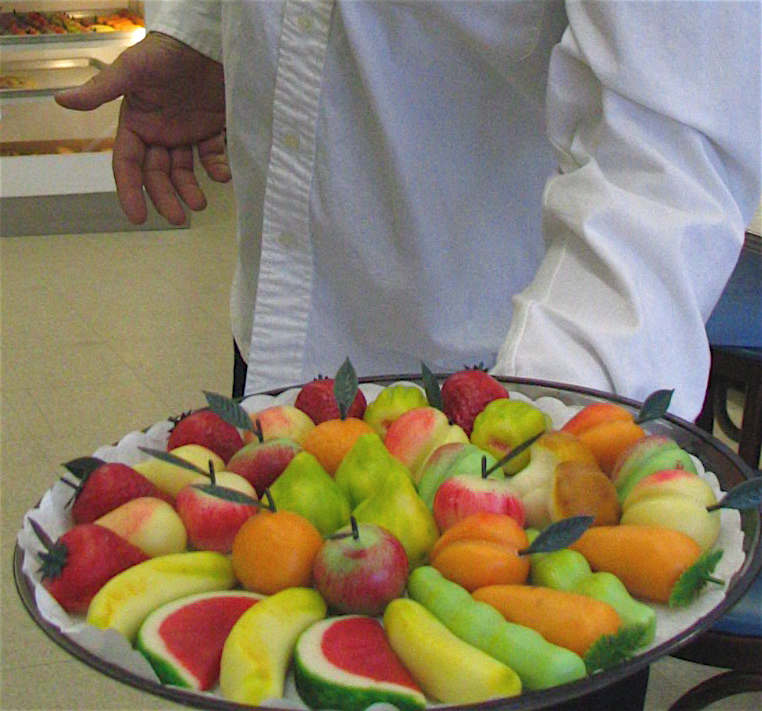
One of our first stops was at Maria's Pastry Shop. Here we sampled marzipan fruits, different pastries, and returned later after the tour and lunch for cannolis and capuccino (and a variety of take home items, including a couple of "sfogliatelle" pastries for my daughter and I for breakfast the next day). Meaning "clam shell", this Italian Neapolitan pastry shell is, to quote from Maria's website, "filled with cheese, semolina flour and citron fruit, mixed with eggs and sugar with a slight cinnamon/orange flavor." The lightly sweetened ricotta filling with a hint of citron was perfect and not too sweet: well worth a return for that alone. Rosemary, herself a former pastry chef, had already figured out how to make the subtle cuts in the dough to mimic the shell. She explained it but I still can't picture it--she'll just have to show me sometime!
A tray of marzipan fruits at Maria's Pastry Shop.


A selection of pastries from Maria's Pastry Shop.
As a mother of three in the rural hinterlands, I am used to large-scale shopping and pantry-stocking. What our day in Boston reminded me about the city, and certainly evident in the North End, is the prevalence of corner markets and different kinds of specialty shopping: where you can do your marketing every day if you want. And WALK there! Here well into the ex urbes, we always say we are about 20 minutes from everything (even though we are blessed with a great village market in view of our house it can't meet every need).

Taking shelter from the rain outside of a North End fruit market.
A wall of historical memorabilia and family photographs at Polcari's.
Like many small North End markets, Polcari's is a chef and baker's dream.
Another stop was Polcari's Coffee, a North End institution and really a packed gourmet market on a small scale. Here we returned later to buy almond paste, cinnamon from Ceylon (more flaky and fragrant than regular cinnamon), and other ingredients to bring home. But the best part of our stop on the tour was a cup of lemon ice served from a large green barrel outside.

A highlight of the day included a cup of lemon ice at Polcari's.
At the end of the day, I brought home prosciutto, several different kinds of pasta and cheeses, polenta, and canned cherry tomatoes, canned Italian tuna in olive oil, an authentic balsamic vinegar (which I never did get to drizzle on Tenney strawberries this year!), a new kind of olive oil, citron and almond paste to try for holiday baking. I also got a packet of imported Italian tomato seeds.
Our guide Joe, a professional chef, shared his favorite
ingredients and many interesting asides during our tour.
Joe's favorite pasta––and now mine when I can find, or afford, it!
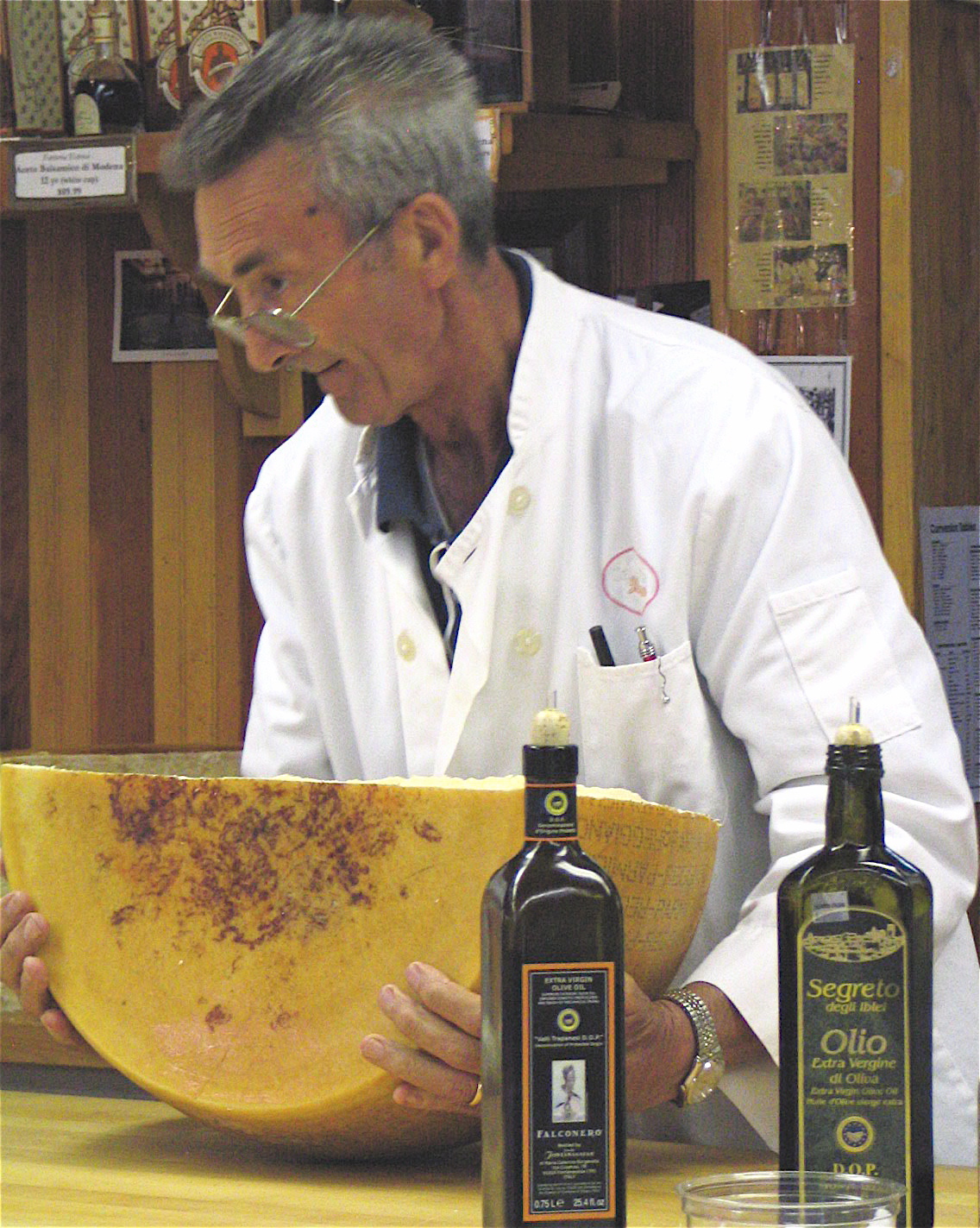
Finesse with a cheese wheel at the
Salumeria Italiana.
I learned about so many different kinds of ingredients on this three-hour tour and a lot of Italian food myths were debunked. We tasted new foods and enjoyed the sites and sounds of a diverse neighborhood. After our tour we had lunch at a small café that was a favorite of Linda's (across from a green grocer's we had stopped at earlier). I had the pasta carbonara and was not disappointed. Our lunch gave us time to pause and fuel up for more shopping at the places we had visited earlier. The day was like a far-off vacation all its own. And from Linda I learned about a new place to park so I can easily return again––2 hours door to door.
A variety of fresh bread in the window at the Salumeria Italiana.

Wednesday, July 18, 2007

The Joys of Jell-0™

LotImg14221
SOME RECENT eBAY PURCHASES [And what DID Mrs. Dewey Do?]

I have had a love-hate relationship with instant gelatin since I was a child. It was often given to us when we were ill and I remember particularly unappetizing red squares of it served in our school's cafeteria on a regular basis (with a dollop of fake, hardened whipped cream on top).

Years ago in the late 1980s, at a Halloween party I threw in the servants' quarters of a Victorian house museum where I lived and worked in Boston, I made a "Dead Yuppie Jell-O". I poured yellow Jell-O into a glass Pyrex™ pie dish, let it gel slightly, and then I placed small, inert, and well-clad plastic Yuppy-looking Barbie/Ken style dolls from Woolworth's. They were lying down, dead you see, and in between them I placed a Rambo-ish guy holding a gun. Eventually the gelatin mixture hardened and the Jell-O art lived in our attic in New Hampshire for a while until it was finally pitched. [Yes, I admit, the whole thing was warped. But fun!]

Now at Easter and other occasions I will make Jell-O salads and molds in various concoctions. In reading old issues of AMERICAN COOKERY (originally THE BOSTON COOKING-SCHOOL MAGAZINE), which was in existence from the late 1800s-1940s, there are scads of recipes for all manner of gelatin and fancy molded salads. Jellies and aspics were more elaborate Victorian holdovers and often served on their own in a large, multi-coursed dinner.

A few years ago I discovered a recipe, blogged in another entry [see: "Five Cup Salad ~ Ambrosia of the God(desse)s!", in the April 2005 archives-April 25, 2005], in a cookbook by Jan and Michael Stern. It is the closest thing to AMBROSIA (made by a neighbor who won't part with her recipe) that I've had:

1 cup mini-marshmallows
1 cup shredded pineapple, drained
1 cup mandarin orange sections, drained
1 cup coconut
1 cup sour cream

Mix, chill and serve.

[Another great recipe is the ORANGE GELATIN or MOUSSE that Neiman Marcus served in their restaurants: I remember lunches at their Boston restaurant, now gone, with my friend Di and her mother Liz. We'd have the chicken salad, popovers with strawberry butter, and the orange mousse, and iced tea. I will have to try to find that recipe--it used to be posted on their website about 10 years ago, but now they have an expensive cookbook. I printed it out and it is somewhere in one of my recipe clipping boxes--and I mean BOXES (I have neat pantries, usually, but I could use a few months to sort recipes and photos.) As I recall it has orange juice, cream and gelatin in it, among other things, and it is smooth and creamy, light and orangey.]

Jello 1

But imagine my joy when I received in my e-mail today an image of the LIME JELL-O SALAD recipe my mother gave to her friend Twila Baker back in Akron days. [I still keep in touch with Mrs. Baker and our Christmas tree is adorned with dozens of handmade felt ornaments she has given to me over the years.] My mother has a REUBEN SANDWICH recipe from Mrs. Baker on the same recipe card--I recognized that funky 1970s pantry motif right away. Oddly, I don't remember this recipe or my mother ever having made it (the recipe is in Mrs. Baker's hand). She writes: "I remember the pink kitchen, and your mother serving this recipe at a luncheon in the dining room." I suspected it was for the occasional ladies' luncheon or church supper. Or one of those foods with too many things in it that I might have refused when I was a finicky child.

Here is the complete recipe (with thanks to Mom and Mrs. Baker):

PAT's (My Mom) LIME JELL-O SALAD

Make according to package instructions:

1 large box lime Jello (using 2 cups water)
3 Tbsps. sugar
1/8 tsp. salt

Add when slightly set:

1/2 cubed apple
2 bananas
1 can drained crushed pineapple (save juice)

Topping:

1/2 cup pineapple juice
1 Tbsp. flour
1 egg, beaten
1/4 cup sugar
1/2 pint whipping cream (1 cup)

Cook first four ingredients in double boiler. Cool. Add cream, whipped. Spread on top of set Jello mixture. Put in icebox.

Tuesday, July 17, 2007

Kool Retro Food Memories (or Cool Whip-R-Us)


12
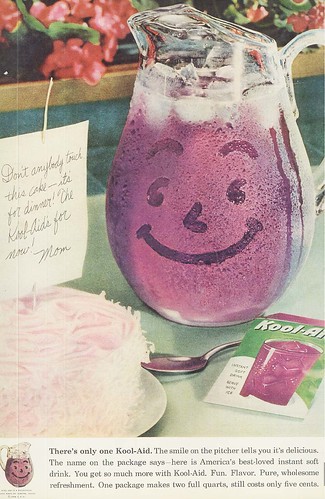
Doesn't that image just bring a smile to your face and make you want to run to the refrigerator and grab a glass of ice-cold fake purple-colored, artificially grape-flavored sugar water? Well, maybe not today but it certainly used to do when I was a little girl begging my mother for some Kool-Aid™ (she'd occasionally cave to my pleas––and "PLEASE?"––in the store). I can't tell you how much I wanted a glass pitcher so I could make a smiley face on the wet perspiration. Instead, we managed with the latest Tupperware™ pitchers with the easy-open pop tops. [Even then I seemed aware that glass made everything taste better.]

I am a child of the 1960s and all of the "modern" food conveniences that were allowed. My mother, an excellent cook and like many of her friends, didn't want to spend too much time in the kitchen unless it was a special occasion or a spree of Christmas baking. Even though they were all stay-at-home-moms in that era, the emphasis was on ease and convenience and not artisanal or whole-food anything (that revival would begin, slowly, in the 1970s). That said, I remember shopping almost daily with my Mom and my brothers at Bisson's Market on West Market Street in Akron, Ohio. It was a small but fine specialty market with an emphasis on good meats and spectacular produce and within a minute by car from our house. Mr. Szabo (I may be spelling that wrong) always popped out of the back and gave us some Brach's candy from the produce section that he managed. As we weren't allowed candy in our house, except at Halloween, that was always a special treat for us. "Just one a piece," my mother would say. No wonder I craved sugar.

It was likely my parents' perseverance, as well as the fluoridated Akron water and twice yearly dental visits, that kept us cavity-free throughout our childhoods. [I was also a certified member of the post-War Baby Boomer "Clean Plate Club" but that is another study in residual childhood food issues, as well as a persistent aversion to lima beans and liver. But I don't blame my parents for turning me into a wayward Foodie--that is just a part of my DNA.]

My Mom, circa 1965, in her pink 1950s suburban Akron, Ohio kitchen.
[NOTE the pink Pyrex™ bowl and her Betty Crocker cookbooks.]

Of course, Mom bought fresh and healthy foods but I noticed an increasing reliance on new foods from the era, ones that food purists today run screaming away from with one look at their labels. Cool Whip™ soon became an essential ingredient of her simple but elegant Strawberry Cake, likely because it could withstand the Ohio summer heat and humidity when placed on the picnic table. Meanwhile, chocolate Whip-n-Chill™ (also available in vanilla and strawberry flavors) was a dessert staple. I remember when they stopped making it--was it all those chemicals and additives? All I know is that it tasted like chocolate clouds, cold and creamy and light. In Florida, my Great Aunt Fran not only made the best Key Lime Pie (with Key limes from her back yard), which I failed to appreciate at a young age, but the very best Whip-n-Chill™ pie. A few years ago I bought some chocolate Whip-n-Chill™, still made by Jello™ but sold only in Canada (like an illicit drug or something), that was distributed through Vermont Country Store (a great place to get retro anything, even when it isn't yet retro). For some reason it still sits unopened in our pantry. Am I afraid it will disappoint? Surely it will not spoil in its dried chemical vacuum-sealed state.

Yes, I have this (as yet unused) cookbook! Chemical confections for every palate!

Later, I believe it was Jello™ that made 1-2-3™ that separated into three layers of the same color but different textures and hues when it set (who knows what lethal combustion of chemicals that required?). That was never as popular in our house but years later when I was writing The Pantry, I learned it had been a favorite in my friend Edie's childhood (and making it in her grandparents' pantry a beloved summer memory). In the early 1970s my mother began to submit to Hamburger Helper™ and like products from Betty Crocker™. Sloppy Joes, a family favorite excepting me, were made with a powdered mix added to onions and hamburger, and heated in the electric skillet before being slopped, warm, on top of Wonder-breadish hamburger buns. Wonder Bread™! I can still see the red, yellow and blue polka dots on the white wrapper but my more esteemed culinary palate hasn't tasted it in years.

Perhaps this is one reason I became nostalgic for pantries before I could even articulate the concept: we just had a broom closet in our small 1950s post-War pink and black kitchen and my mother did not store a lot of food simply because we didn't have the room. With a market around the corner selling the latest processed food products, who needed an old-fashioned pantry? Instead, breakfast nooks were included in new kitchen designs and families ate together in the kitchen. The days of the butler, or even a waitress for an upwardly mobile middle class family, had ended with the First World War.

Going to the grocery store was a social occasion for a stay-at-home Mom on any budget. Our pink fridge, an appliance color that I did not appreciate until recently (even though I would not dare use it today), became another kind of pantry with its freezer and ice box capacity. Meanwhile, homogenized milk and dairy products arrived several times a week from a Reiter Dairy milk man in an insulated tin box on the back step (or "stoop" as we said in Ohio, certainly from the strong Midwestern Germanic influence).

Me, c. 1965, no doubt waiting for a chocolate chip cookie.

But I loved the concept of processed food and the whole marketing pitch and packaging that went with it. I noticed these things because I studied the ads in the house and garden magazines I poured over in the living room (or even in black and white ads on television). I feared the tall, bald Mr. Clean™ in the household aisle of the grocer's as much as I thought the Jolly Green Giant™ would reach right out of the freezer case and put me into a bushel of peas. These guys were as real and looming for me as the Big Bad Wolf.

In my pink-cardboard play kitchen under the cellar stairs, along with my fake food!

Another culinary fixture of growing up in the 1960s was the frequent use of Betty Crocker's Picture Cookbook (I believe the 1956 edition), as well as Betty Crocker's Cooky Cookbook of the same era. Both had been bridal shower gifts to my mother in 1961 and were the kitchen bibles and some of the only cookbooks she owned at the time. I enjoyed looking at the images of brightly colored plates and food styling, even before I could read, and eventually learned to bake and cook from those books (once I'd graduated from my aqua Easy Bake Oven™). My mother made Cottage Pudding and Golden Sauce on the rare occasion that my Grandpa came for dinner and different cookies from the "Cookie of the Year" section at the back: especially the Toll House (1946, I think?). When my parents bought a wok in the early 1970s the first thing they made was Sweet & Sour Pork--my mother labored over it all day while my father kept us away from the kitchen, knowing that we'd blanch at the thought of having to eat something so exotic (he was right).
af_1.JPG
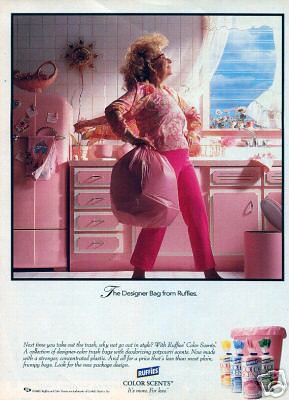
The Pink Kitchen Strikes Again! (ad from early 1990s)
I'm not as nostalgic for these foods for their flavor as I likely am for their associations and vivid packaging. I would not dream of buying Hostess Twinkies™ or Ho-Hos™ or Hamburger Helper™ today for my children--instead, I try to make them myself, supplementing chocolate whoopie pies or sponge cake or Tailgate Casserole (a delicious ghoulash of egg noodles, hamburger, several kinds of cheeses, and tomato sauce all layered together) for the boxed foods of the past and present. But the Pillsbury™ Dough Boy can visit my kitchen anytime, and often does, when I just don't feel like making homemade biscuits. [Come on, I'm not that much of a food snob! Even though I'm not sure what comprises the crystallized chunks of transluscent grease in their Grands™ biscuits...]
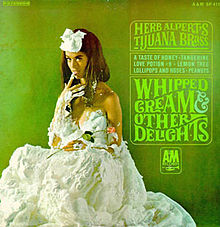
Once in a while I'll get a craving for a Fresca™[remember when they made it like Sprite in the 80s and then, thankfully, changed it back again?]. I'll pop a can open and pour it over a tall glass full of ice, take a sip, and be transported back to Akron on its grapefruited effervescence. It's a hot summer's day in the 1970s, I'm watching billowing clouds pass over our small suburban lawnscape and I hear the bubbly, happy sounds of Herb Alpert & the Tijauna Brass wafting from the hi-fi inside, perhaps from the album Whipped Cream and Other Delights. And I'll bet that model was covered in Cool Whip™.


POSTSCRIPT July 18: I really should add that Herb Alpert and the TJB were Grand Marshalls of the Akron Soap Box Derby Parade one year in Akron––I'm guessing late 60s as I couldn't have been much older than five. My mother, who was home with my baby twin brothers, couldn't attend. My father, who was branch manager of a bank dowtown along the parade route, was able to get me, and our friends Diane and Bill, in the bank after hours to watch the parade. I'll never forget Diane, who like my mother thought Herb Alpert was the cutest thing (he was!), hanging out the second story window, in between fluted limestone columns, as the float went by. "Up here, Herb!" she yelled and waved amidst the noise of the band. He looked up at us and flashed that magic smile. I see him now, one of those indelible images from childhood memory, the float in slow motion and the colored ticker-tape and confetti raining down. A magic summer moment. But I've always been sorry that my mother missed it.
Saturday, July 14, 2007

The Old Farmhouse

IMG_8532

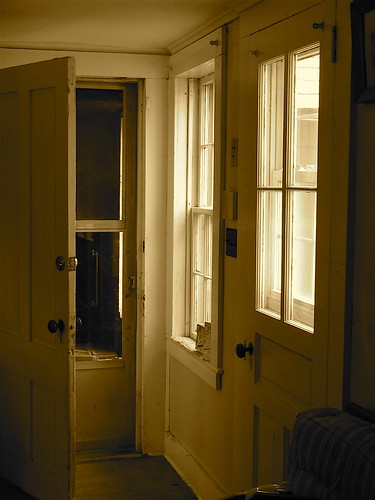
As many of you know I am rather partial to old farms and farm things and farmhouses--today these undisturbed places of the past usually exist only in writings and photos and memory. Rarely does one stumble upon an actual preserved farmhouse but we occasionally do--either through friends and acquaintances that we meet or through the odd occurrence of an on-site auction. In early June my husband, daughter, friend Rosemary (a frequent blog fixture), and myself went to an old farm in Keene, New Hampshire that had recently left the ownership of two sisters in their 90s who had lived there all of their lives. Richard Withington, himself 90-something, an auctioneer from Hillsborough had the listing. Lured by the prospect of "items from the pantry" on the auction flyer, we were able to get in before the preview and see the house.

IMG_8560

The farm--and its 100 acres (a classic farm size for self-sufficiency)--is just out of reach of suburban Keene in southwestern New Hampshire in an area that is still surprisingly rural. It had been sold a year or so ago to a man who bought it furnished as a place for his mother to live. However, it still retained the same atmosphere and contents of its previous owners. This kind of Federal farmhouse, large and boxy with a central hall, was once common across New England landscapes.

IMG_8528

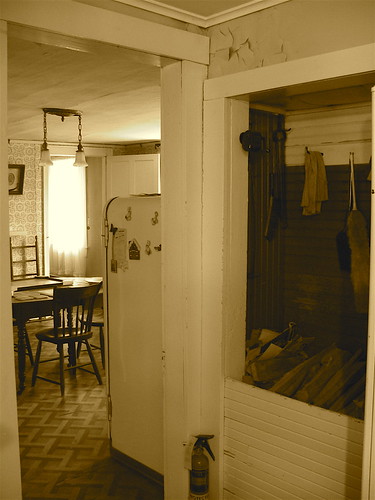
The kitchen like the rest of the house, was untouched, and a place the present owner said he would keep the same if his wife let him. I wasn't clear if he was selling the house eventually or just the contents but it was a privilege to see the house before any restoration would occur. There was also a tinge of sorrow seeing an old place like that leave a family (something double-edged for me).

IMG_8561
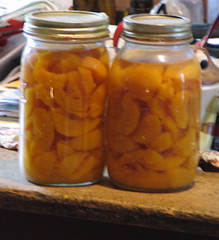
CANNED PEACHES in the KITCHEN

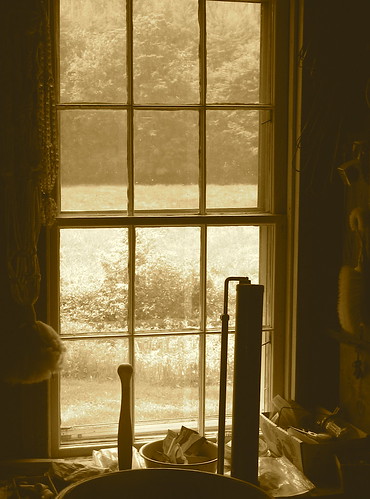
A large buttery (called butt'ry--a form of pantry that was popular in early American farmhouses) was just off the kitchen in the northwest corner of the ell, outfitted in plain pine boards from the 19th century, a large window for ventilation, and plenty of storage. These were originally quite commonplace in New England farmhouses as places for food storage and support for the kitchen. Cool, efficient workrooms, butteries provided the space and storage that a primitive kitchen, bereft of cabinetry, did not.

IMG_8521
THE BUTT'RY WINDOW

IMG_8529
THE WOOD BIN in the KITCHEN

Other rooms, like the parlors and hallways, and upstairs bedrooms, and even the light fixtures, reminded me of the farmhouse where I grew up. My daughter Addie caught the old smell of aged wood and closed-up antiquity that she remembers from visiting the Gibson House in Boston when she was just 13 months old, where I once worked as a resident guide. "There's that Gibson House smell again," she said. For me, smell is the most resonant of my sense memories.

IMG_8547
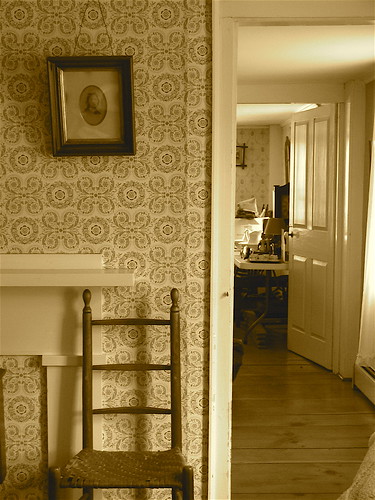
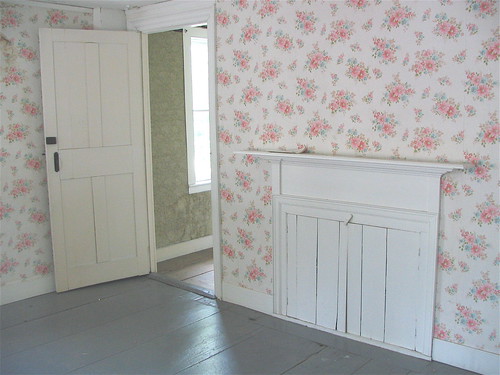
AN EMPTY UPSTAIRS BEDROOM WITH VINTAGE WALLPAPER

Upstairs there were sparsely furnished bedrooms and several caches of items that would go at auction. A front hall closet over the stair hall was a reminder of the two in our own Federal home (one is now my office which looks out over the Main Street of our village, the other is a closet). My office was a small nursery space for our son Henry but it became, out of necessity, my own little office and I wouldn't trade it for a larger space in the house. It could easily be made back into its original space--a hallmark of any careful house restoration.

IMG_8553

In our own home, we have always thought these closets might have originally been small bedrooms. Our house is a double house, a Federal duplex, really. Built by two brothers for their families in 1813, there is an unusual mirrored quality throughout, a kind of double symmetry in a further extension of the classical Federal architectural house form. The closet door was even constructed in the same manner as our two--with a window to illuminate a dark hall. Inside were hung some old clothes, presumably from the sisters, a somewhat disconcerting site.

IMG_8543
OLD FIXTURES in the ONLY BATHROOM

IMG_8541
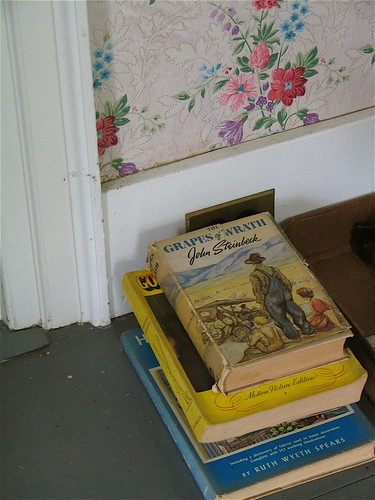
A PILE OF BOOKS AWAITS THE AUCTION

IMG_8558
A PARLOR STASHED WITH ITEMS FOR AUCTION

We went to the auction later that week but didn't stay. It was overwhelmed by people and items that we didn't want or need, and few contents from the pantry that we could find. But it was sad to see the crowds of people rummaging through the piles, hoping for something old and valuable to keep or sell. Seeing the farmhouse before it lost its placefulness, or any vestige of the two sisters, was enough for us. So we left, before the first strike of the gavel echoed under the tent and across the new mown fields.

Summer Squash Casserole Recipe


"Mrs. G." has asked for my summer squash recipe in the prior post so I am happy to submit it here.

Summer Casserole

For lack of a better name, this dish has always reminded me of August when the squashes are large and plentiful and the tomatoes are big, ripe and really red. It has been a staple--and often a main dish--at summer gatherings from my kitchen for over 25 years since my one of my best friend's mothers (from Akron, Ohio--thank you Mrs. Lewis!) gave me the recipe in 1978. It is a great way to get rid of overgrown zucchini but works just as well with smaller, less seedy squash, too. It is easy, cheesy and delicious. With the abundance of shredded cheeses on the market now, too, in endless variations, it is fun to try different varieties (I find a combination of Monterey Jack and mozzarella is the best). It is very satisfying and I believe will work for most low-carb or vegetarian lifestyles, too. [My mother used to make a complete meal by adding a layer of cooked ground turkey but I like it all-vegetable.]

  • 2-4 medium-large summer squash (combination zucchini, yellow squash or what have you)
  • 1 large yellow onion (or several medium)
  • 2 large vine-ripened tomatoes (any kind will do)
  • 1 16 oz bag shredded mozzarella (or cheese of choice: Italian combinations work well, so does 8 oz of one kind and 8 oz of another)
  • 1 package of sliced mozzarella (enough to cover a 9x13 pan)

1. Take a 9x13 baking dish, or lasagna pan, and butter moderately.

2. Slice equal parts zucchini and yellow summer squash, not too thin and not too thick.

3. Slice large onion, not too thin and not too thick. (Or, several medium-sized)

4. Silce 2 large beefsteak or comparable ripe tomatoes, not too thick and not too thin.

5. Starting with a layer of squash on the bottom, alternate layers of squash, onion, shredded cheese, squash, onion, shredded cheese, squash, ending with tomato layer on top. If desired, use fresh ground pepper and fresh herbs in between layers, too. Also, if you have enough tomatoes you can put a middle layer of tomatoes in between one of the squash-onion-cheese layers.

6. Put sliced mozzarella over the top layer of tomatoes (you can also use another few cups of shredded cheese).

7. Bake at 350-375 for approximately 45 minutes until bubbly, The thicker the squash the longer the cook time. The whole casserole will compact a bit.

8. Let sit for 10 minutes or so: it will cut easier when a bit cooler.