
Monday, August 13, 2007

Landlines

IMG_9641

This weekend was Medal Day at MacDowell Colony, an artist's retreat in Peterborough, New Hampshire. It was also their centennial celebration so there was lots of extra fanfare. Even though I drive by the colony almost daily in some form, as it is just fifteen minutes from our house on a lovely back road to Peterborough, I have never been on its grounds. Growing up, my grandmother always spoke of it in hallowed tones: of how Thornton Wilder was a friend of her older brother and wrote OUR TOWN there, of how this incredible woman named Marian MacDowell, who died in 1956, had been the driving force in fostering this arts colony in the New Hampshire hills. I think, like myself, my grandmother secretly longed for such a place to go and write or create.
IMG_9659

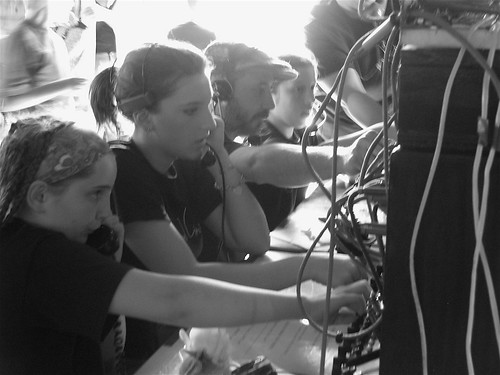
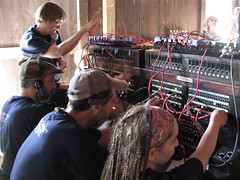
My daughter and I had the opportunity to participate in a unique public art installation project called "Landlines". Conceived by artist Anna Schuleit, the project placed 100 telephones of all eras and styles throughout the forests and edges of fields in the 450 acres of the colony. At certain times throughout the weekend, former colony fellows and others were asked to call in from anywhere in the world on a toll-free number and were routed through two old-fashioned switchboards (where switches were used to link calls). Visitors wandering the grounds could call from tree phones to talk with anyone on another tree and incoming callers could talk with tree phones (or hear a recording of something written or composed by a MacDowell fellow). The wiring and orchestration that went into this was boggling.
IMG_9642

Chris Ricciotti, the partner of an old colleague of mine, John Burrows (who is a Victorian design merchant), organized the mechanics of the installation with the use of his expertise and collected switchboards. A large team of volunteers coordinated the phone placement and the vast wiring that was needed around the grounds. My friends Rosemary and Edie also participated in the switchboard project: Rosemary was a cook at MacDowell a few years ago and was delighted to tour their renovated kitchen and Edie was also employed there in the 1980s. [Edie's husband Jeff also helped with the wiring and their son Ko, almost 12, was a whiz at the switchboard.]

IMG_9640
CONNECTING NEAR A TREE PHONE

The MacDowell Colony, even in this modern age, does not allow telephones (and I believe politely requests that residents do not bring cell phones but I am not certain of this--my guess is that they don't come in well there any way as coverage here in the Monadnock foot hills is sporadic). The idea is for the artist or writer to compose freely without distraction in small private studios. The only existing landlines on the property are the ones in the administrative buildings (and all electric powerlines have been buried between studios). The thirty or so studios are connected by footpaths as in an idyllic woodland camp.
IMG_9669

Breakfast and dinner are provided in the main building--but a lunch basket is packed and quietly left on studio porch doors--and days can be planned and carved freely around the creative impulse. No one is there to tell you what to do, but like college or the parental embrace, your every need is met while you are there. Your time is your own.
IMG_9645
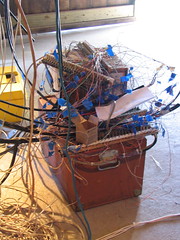
TANGLES OF PHONE LINES REPRESENT HOURS OF WORK BY VOLUNTEERS

So to have this immense network of phones throughout the forest and connected with the world--in a non-computer driven or cellular way--seemed a fitting tribute to a place that has done so much for the arts and culture of the world, that is connected and yet apart from it.

I have come to loathe talking on the phone since the invention of e-mail. I don't like to spend a lot of time conversing on it and find it a constant intrusion. So this project intrigued me on a variety of levels. When we had our switchboard training, I was overwhelmed by left and right, different wires, procedural order, etc. So I gladly allowed my daughter to fill in for my 15 minute shift while I observed. I wanted to talk but was leary of the mechanisms which I seemed unable to understand (John told me that it normally takes several months to train a switchboard operator in the old method). I was amazed how the younger volunteers, especially, handled themselves with the mechanics of it so effortlessly.
IMG_9638

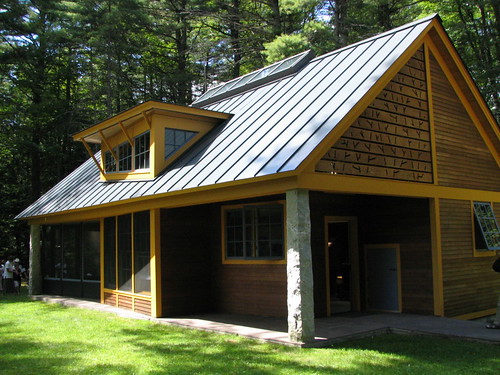
We had a bit of time to visit one studio before we were at the switchboard. I was drawn to a contemporary looking studio, Calderwood, at the edge of the field where we parked. Designed especially for writers, apparently by I.M. Pei or with his blessing, it was the size of a small and comfortable house complete with a large light-filled workspace, kitchenette, bedroom (with bathtub under a window seat that my daughter noticed through the window), a reading loft and even an inglenook with a fireplace and more cozy spaces for reading or visiting.

IMG_9633

I could have moved right in. [Most studios just have work and napping spaces with dormitory space provided near the dining hall but this one had a complete bedroom.]
IMG_9636

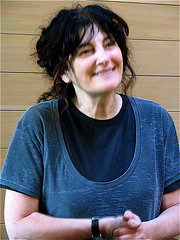
But inside was Ruth Reichl, writer and editor of GOURMET magazine. I enjoyed her first two memoirs: TENDER AT THE BONE and COMFORT ME WITH APPLES. She was surrounded by well-wishers and I was too shy to say hello (even though I'd kicked myself for not bringing her books to have signed). I would think such a situation would be so awkward: all of these people in your private writer's space. I felt permissably intrusive as if seeing the space and her in it was enough. So I smiled and snapped her photo--perhaps an invasion in itself, also.

Even though the grounds were bustling with people from all over New England and New York, even the world, it seemed, and many locals whom I knew, I did feel somewhat transported by my brief time there. My daughter Addie felt it, too. It reminded me of a hushed outdoor library with much creative energy infused in the forests and fields and footpaths.

And the "Landlines" installation furthered that creative buzz. The forest is quiet again. The place can withdraw from the world as it does on every other day of the year except for Medal Day. Ruth Reichl said she was leaving today to go back to work in Manhattan. I wonder if she was ready.

Monday, July 30, 2007

Grandma Love

IMG_9472

I troll a lot on eBay (ok, I buy too--is there a 12-Step program yet for eBayers?) and one thing I collect, among other things, are old farmhouse aprons. For some research I am doing, I recently did a search on eBay for "old farm photos" and was amazed at the amount available. Several sets, both offered by the same seller, caught my eye and I bought them at a low, and only, bid. I was attracted initially by the apron worn by Grandma Love (which, no, didn't come with the photograph!) but also her weathered face and rural surroundings--and that wonderful name which conjures so many good things about Grandmothers.

They are black and white and from the earlier part of the last century. One set is from a small farm in Coalgate, Oklahoma and depicts "Grandma Love" in several shots, one with a young boy, Buck Jones, perhaps her grandson. On the back they are marked with the names and the place and the date: Thanksgiving, November 25, 1948 (only seven years after President Franklin Delano Roosevelt declared the fourth Thursday in November to be our official day of Thanksgiving). It must have been a warm day, given their clothes and no appearance of snow. Coalgate is a small town in southcentral Oklahoma, with just over 2000 people in the 2000 census, and apparently has a mining history as well as a museum to mining.

IMG_9474

That night, after dinner, Grandma Love and her family likely gathered around the wireless and may have heard a special Thanksgiving installment of THE ALDRICH FAMILY. Or, perhaps they listened to a more chilling episode of SUSPENSE which starred Agnes Moorehead, Margaret O'Brien, and Lurene Tuttle, among others, in "The Screaming Woman," adapted from a Ray Bradbury short story. The plot involved a Thanksgiving setting and describes "little Margaret," who "can hear a woman screaming from beneath the Earth. But when she tries to convince her parents of what she hears, they don't believe her." Grandma Love may have even been aware that the first wide-audience television broadcast was made on November 25, 1948, if the radio or newspaper told them about it. Television likely didn't come to their farm for several more years, at least.

IMG_9479

Grandma Love must have had some hard years on the farm: managing through the Great Depression, the Dust Bowl, several World Wars, long hot summers with inevitable tornados followed by bitter prairie winters. One can only draw so much from a photograph and it is what is not said that is so intriguing. What saddens me about seeing old photographs like these in antique shops, yard sales, or on eBay (and these are the first photographs I've ever purchased) is that they are someone else's relatives or homes--someone else's history. I feel somewhat intrusive for even looking, let alone buying and wondering about them.

IMG_9476

These photographs belong in a photo album or at least an old trunk in a relative's attic or a bureau drawer. Unless the people depicted wrote letters or books that have been preserved, these forlorn images are likely the only trace of them. It gives me pause to think that we are truly passing through this life and eventually are forgotten. I can't imagine letting photographs leave a family but perhaps in an estate sale, when there is no one left to claim them, that is the only thing left to happen. Better that than to burn them or throw them away.

IMG_9477

So many photographs are unidentifiable either because everyone who knew the people or places in them have passed and can not provide information about them. Or, in most cases, no one has taken the time to write on the backs of the photograph the basic information like "who, what, where, when." Another reason I was drawn to these photographs was because this information was provided, in artful longhand, on the backs. Someone took the time and care to document them for posterity.

Seeing Grandma Love has provided me with two impulses: to finish archiving the family photographs from my mother's side and make digital copies for everyone in my family (not to mention organizing the many photographs, slides and digital images I have taken for the past 25+ years). And, if anyone should find this blog through a search on Grandma Love or Coalgate, Oklahoma (or young Buck Jones who is depicted with her--he would likely be in his mid-60s today as I'm guessing from the photograph he is about 7 or 8--there is also another photo taken on this farm of a middle-aged woman in round spectacles marked "Mom" with the same date) and can make a reasonable claim to them, I will happily give them to their rightful family. In the mean time, I will contact the eBay seller to see if she can provide additional information. I have also briefly checked for a local historical society in Coalgate but have so far come up short. In the meantime, Grandma Love is welcome to stay with me for safekeeping.

Saturday, July 28, 2007

God, the Universe and Everything

IMG_5829
THE SPARE SIMPLICITY of the SHAKER MEETINGHOUSE (and service) in SABBATHDAY LAKE, MAINE APPEALS TO ME NOW

Lately I've been thinking a lot about God--especially the kind of thoughts I often return to when in doubt. Not the "why me? why does God allow any kind of suffering?" kinds of questions--more of the "does God really exist?" kinds of questions and, is there really an afterlife? As a child, I just always believed in a man with a flowing white beard and a wise, unconditional benevolence--like Santa Claus, only for Sunday school class (and from the pictures I saw of God and Jesus in THE CHILDREN'S BIBLE or the Cecil B. DeMille grandiosity of THE TEN COMMANDMENTS and Wiliam Wyler's BEN HUR).

My first church school song was "Jesus Loves Me This I Know, For It's In the Bible So" Who could argue with that? We attended church, I was in several youth choirs, and when we moved to New Hampshire I became an acolyte and was soon after confirmed in the Episcopal church. I went through the motions because it was my familiar. Meanwhile, in two years of religion class in parochial school, I asked about graven images in the prevalence of crucifixes and statuary of saints everywhere and the relevance of loads of daily "Hail Marys". Rather than discipline me, Sister Catherine Feeney seemed to welcome these questions and for this I have always been grateful. The architecture and ritual of the two churches I grew up in--Westminster Presbyterian in Akron, Ohio and All Saints' Church in Peterborough, NH--were of special importance. Their associated music a close second, furthered by my father, a church organist and Classical music buff, who supplemented my musical education.

As a child I always knew my parents would answer persistent questions on all subjects and even if they did not have an answer that they were the ones worrying about these questions, perhaps, and that in my asking them, I was somehow relieved of their burden. ["The remembrance of them is grievous unto us; the burden of them is intolerable..." Confession, Rite I, COMMON BOOK OF PRAYER]. I was sheltered in the comfort of my parents taking care of things: food, clothing, shelter, education. At the same time I learned that the order of the world does not always stay the same: adolesence, my parents' divorce, new school and friends, and several family tragedies rocked our familial havens.

Now that I'm in the position of being a parent myself, with one of my parents deceased, I am the one faced with these questions with no real buffer. Like it or not, I am firmly in my middle-ages (staring down 45 in October which somehow is more unsettling than 40 ever was), and I find these old unanswered questions returning. If I was an apostle of Christ, I would certainly have been Thomas, the doubter. I've always questioned everything in my life because it is my nature as a researcher, writer and a woman who thinks about too many things sometimes. I brood, I worry, I analyze. I never believe everything I hear or read.

Many would tell me that we shouldn't overanalyze faith or a belief system but yet I am so untraditional in my approach to everything that I can never accept something blindly, even "the knowledge and love of God". If I am anything in the dogmatic sense now it would be a nineteenth century Transcendentalist who saw God in nature and a divine order to things. I don't know why religion or God--or any spiritual discussion around a belief system--is so uncomfortable for some. I find it endlessly fascinating. If I meet an atheist, which I often do, I am as intrigued by their reasons for not believing in a divine power or creator as I am by those who are so sure that they want to convert everyone they meet. [My first of many experiences of this was when in third grade, the parents had a church meeting after a potluck and the children were led upstairs to a Sunday school room. An evangelical couple told us, "If you do not accept Jesus Christ as your own personal Saviour right now, you will go to Hell." I was eight. Even then, I doubted that even God could be that judgmental--but humankind has certainly proved to be.]

Sometimes I want proof of an afterlife, of a creator. I have had glimmering experiences of the supernatural, in the other-worldy (and not in the bad sense, unless you count some strange adolescent experiences with a Ouija board--which should NOT be sold as a game, in my opinion). But it is never enough "proof" for my questioning mind. Even science seems to try and diminish the near death experience (NDE) as the brain shutting down. I read two books this winter about NDEs: one about a Baptist minister's 90 minutes of being clinically dead and the other was MY DESCENT INTO DEATH by Howard Storm. A complete atheist at the time of his "death", this man wrote of being plagued by torture and demons to an emergent and life-changing transcendence. It was such a life-altering experience that when he was revived and eventually healed, he became an ordained minister. [On my reading list for the winter are some books by Trappist monk Thomas Merton and I'd also like to take a crack at the current bestseller GOD IS NOT GREAT: HOW RELIGION POISONS EVERYTHING by Christopher Hitchens, whose viewpoints I find refreshing in VANITY FAIR.]

Several years ago we heard from someone in regards to a difficult, extended situation which will likely never settle out again into the way things used to be. I have kept this e-mail because it has resonated with me and I have thought of it often. They wrote: "Each unit must create its own island of peace and love.  If we are not good for each other, at least let us be good parents and good neighbors to those we encounter every day.  We can not change yesterday - we can only live today, be thankful for our gifts and reach out to those in need." What better expression of the Golden Rule and the sentiment that everything good in our society starts at home and from within?   

The other day on my Widgets, where I have a biblical verse of the day that pops up, the following verse from 1 Peter: 8 spoke to me: "Though you have not seen him, you love him; and even though you do not see him now, you believe in him and are filled with an inexpressible and glorious joy." I don't believe I've ever read or heard a better definition of faith and I'd never heard that particular verse before. Last night when I was reading Susan Cheever's memoir of her father John Cheever, HOME BEFORE DARK, she mentioned the Japanese print on their wall to which her father refered when he learned he was dying of cancer: "Do you know what that says?" my father asked me, as he lay there the Christmas before he died...'Because you can not see him, God is everywhere.'" [Yasunari Kawabata, 1899-1972] It seemed another way of saying what Peter had meant, circa 60 A.D.

Today we were watching an old Granada film, THE KINGFISHER (1982), starring Rex Harrison. He was a dottering old bachelor trying to rekindle an unrequited love of fifty years prior. He quoted from this Victorian poem by Arthur Hugh Clough (1819-1861) and it reminded me of how I often turn to prayer only in times of great need:

"And almost everyone when age,
Disease, or sorrows strike him,
Inclines to think there is a God,
Or something very like Him."

A friend recently told me, "I know there are things I can't possibly explain, so I don't worry about them." But this week, like the bibliomancers who opened the Bible or other books with a specific question and let their finger fall to a spot with their eyes closed in search of an answer, I have been hit on the head with several literary and biblical answers to my own questions. A firm believer in symbolism and coincidence (or "coinky dinks" as my friend Sue likes to say), I can't help but think someone is trying to tell me something. Maybe I should just listen for a change.

Thank you!

Today it is raining and quite tropical in southwestern New Hampshire. It has been a cool summer, with mostly dry, warm (and sometimes hot) days, and just enough rain to keep from having to water regularly. Today is the perfect day for a blog or two and lacking anything substantial of my own to say, I did want to pause and say thank you: to all of the readers of THE PANTRY and to those who have taken the time to find and read this blog, or to return to it, or to e-mail me directly on my website.

I'm glad the book is finding readers who share my enthusiasms for pantries and kitchens and domestic history. I will continue to post press updates from the media on my website at www.catherinepond.com (with links to reviews and articles whenever possible) and places where I will be appearing.

I was just notified that the book was accepted for the Kentucky Book Fair in Frankfort on November 10, where I will be for the day. There will also be a feature article on THE PANTRY in the upcoming NEW HAMPSHIRE MAGAZINE (September), and there was a review of the book in the August 2007 issues of OLD-HOUSE INTERIORS and ROMANTIC HOMES, both on newsstands now.

I continue to look for pantry references in literature and non-fiction, in advertisements and vintage images. Call it an obsession, perhaps, but clearly the writing of the book has not ended my interest in pantries. I am currently developing a series of lectures to take on the road to historical societies and other organizations about the domestic history of kitchens and pantries in America. More information will be posted on my website this fall.

Many are asking "what's next?" I'm not certain of that myself--and sometimes that is part of the fun. I do know after a summer of enjoying a lot of time with my family and in the garden and piles of reading (and doing pantry-related press), that I will be ready for a more structured fall and winter. I'll keep you posted.

Monday, July 23, 2007

Summer Antiquing

4ac5_3.JPG
A 19th CENTURY FIRKIN from an OLD MAINE FARMHOUSE

When I was a child, summers in New Hampshire were not complete without a country auction or two. I remember an auction in Jaffrey Center where my mother bought a pair of forged iron fireplace tongs and a large serving plate. I could have cared less about antiques back then--and my parents weren't really into them either (that was my only "antiquing" memory from childhood, although I was surrounded by old things in my grandparents' homes). However, in those days I liked to pick up "old" blue willow plates for a dime or quarter at yard sales in the area. At home in Ohio during the rest of the year I collected all sorts of things: dolls, Breyers horses, Nancy Drew books, and my New England stash of blue willow plates (most of which could likely be found at any hardware store). Looking back, I realize I was as obsessive about collecting those things as I am about the many things I collect now. Need, want and covet--I could write the book about the differences, and the similarities, between those words.

On Saturday we went to an estate sale in an old house across the street from ours. The woman who had lived there, Helen Trook, was a collector, too, and apparently the world knew it as many people showed up at her door for the 10:30am opening. The house was tightly packed with things, people, small rooms and was, truly, a madhouse (and now I see why I prefer eBay or a good buy at an antique shop). We were able to get in on the initial stampede but when I returned later when the crowds had diminished, I was able to linger over her cookbook collection. I appreciate a person who collects cookbooks and then writes little notes in them, too, or stuffs them with other recipes. So I was able to add to my own collection and feel better knowing from whom these new additions came.

IMG_9455

In the afternoon we headed over to Fitzwiliam, which like Hancock and Jaffrey Center, is an historic town in southwestern New Hampshire with a village green, well-preserved historic homes and a distinctive meetinghouse (in fact, the same builder worked on two of them). The Fitzwilliam Historical Society was hosting their annual antique show on the green, complete with restored fountain and picturesque summer day: not too hot, not too cool, puffy clouds wafting along.

We hadn't been to this show in several years and it was interesting to see how dealer offerings have changed--and to also watch the crowd (I often thought I was in Litchfield County, Connecticut). Last time we attended this show there was a prevalence of English Staffordshire and American yellowware. This year, it was as if a number of old New England farm pantries had been emptied: loads of firkins (in various states of condition and old original paint), early baskets, woodenware (bowls and other primitive utensils), and pantry boxes. Before plastic was invented, or even tinware, woodenware provided essential dry food storage in New England farmhouses. These relics--once tossed like so many old wooden things were--seem to be quite collectible now and eBay is also a good indicator (the green firkin from a Maine farmhouse, pictured above, will likely go for well over $300 on eBay tonight).

IMG_9462
BLUEBERRIES for CATHERINE

I was delighted to find a small and affordable yellowware bowl in a pattern from a set my father had given me years ago (from his kitchen, via my grandparents, via his grandparents): early Robinson Ransbottom (probably 1920s) from Zanesville, Ohio with a hobnail design on the side and a blue salt-glazed rim. [Robinson Clay Products, formerly of Akron, Ohio, merged with Ransbottom in southern Ohio sometime during the early 1900s.] Their crown insignia is just recognizable on the base but only to someone who knew to look for it as it was barely evident. I did not know, but should have suspected as much, that the bowls came this small (5" across and 2.5" high: holds less than a pint). So now I have a complete set. The dealer did not know the origin of the bowl and that likely contributed to its reasonable price. I also got a sweet little tin berry pail with cover, perhaps for a child, for about $20, and a few other finds.

I was also glad to run into Susan Bates, the proprietor of The Cooperage, a lovely antiques and garden shop in Townsend Harbor, Massachusetts [www.TheCooperage.com]. She displays everything so artfully in her historic shop, which is owned by the Townsend Historical Society (their Reed Homestead is next door) and I was drawn to her booth by her distinctive plant arrangements and plant stands and then realized it was her. She wants me to come down and do a program on THE PANTRY book and I'd be delighted. I've found many great things in her shop over the years and need to get down there again.

After our antique afternoon, we ventured over to Jaffrey Center where I was the featured speaker at the Village Improvement Society's 101st annual meeting [www.JCVIS.org]. Melville Academy, where the meeting was held, is a well-appointed museum of Jaffrey-related history and Americana and is well-tended (one of the pantries featured in THE PANTRY is from Jaffrey Center, also). I grew up in Jaffrey and for a long time was part of the historic district commission there. In many ways it was like old home day, even though we only live thirty minutes to the north. I spoke about THE PANTRY, signed some books, and savored memories of childhood and the years before my marriage. [Jaffrey Center is home to the Amos Fortune Forum, an excellent series of lectures each summer, as well as where Willa Cather is buried behind the old meetinghouse. Mount Monadnock, a geographical fixture in the region, looms in the background.]

The day would have been perfect had we been able to have dinner at Aylmer's Grille [www.AylmersGrille.com] in downtown Jaffrey (which is having a much-deserved rebirth) but, alas, we did not have reservations. Aylmer's is run by chef Aylmer Given, a Jaffrey native who returned a few years ago to have a restaurant (and I went to high school with several of his siblings). Small and bistro-like, the food is delicious and the menu not overwhelming. It is the kind of place where you want to linger over a meal and chat, which I have often done for lunch with friends (but had never been for dinner). To see well-clad diners, none of whom I knew, in the former location of The Rusty Bucket (and a great breakfast/lunch place in its 1980s heyday) brought a wry smile, but I was delighted all the same.