Iwill never forget that moment when I held and opened a copy of my first book, The Pantry–Its History and Modern Uses, for the first time. It was more euphoric than when I saw my first published article, back in the January 1990 issue of Victoria Magazine (the original Hearst version) on my several years living and giving tours at the Victorian-era Gibson House Museum in Boston, Massachusetts. But it was a similar, once-in-a-lifetime experience: because there will never be a first book, or a first article, again.
The comparison to writers opening up their published books for the first time to holding their first child, or any of their babies, is very apt. The labor that goes into a book, the timeframe, the expectancy, the wondering, the fretting (the "will other people like it?"). All of it. It's very similar because, as with a child, you are birthing something from your heart and soul and mind. And unlike a child, a book has a longer shelf-life. It might exist for centuries and it is its own kind of legacy.
But yet, no, nothing is like holding your newborn for the first time. That is in its own special realm!
I am working on several other books right now and will keep this blog updated and at my more active blog on our farm life in Kentucky, Farmwife At Midlife.
The Pantry is still available via my website, only $20 postage paid (USA). The original cover price was $16.95 and is still that, if not less when you consider that postage has gone up in the past decade (even media mail, which is the most affordable way to send and actually quite quick, too).
I am happy to sign your copy, or inscribe it, and send it out as soon as possible (which is faster now that spring is here and the roads are clearer...well, or as life is less complicated as it has been).
Today, April 21st, is also the 12th anniversary of this very blog, started while researching and writing the book. A lot has happened in social media since that time and I still enjoy blogging over at "Farmwife at Midlife" which has had a recent revival of sorts.
Today, April 21st, 2015 is the 10th anniversary of this blog and of my blogging anything at all, in fact. I don't post regularly here any more but there are many changes taking place over at, or related to, my Farmwife at Midlife blog writing. I'll be detailing everything there in the coming weeks.
In the meantime, The Pantry-Its History and Modern Uses is still available from my website.
I will continue to post pantry-related updates as I can as pantries will always be in our lives. You can follow our continued farm life over at my other blog even though I detailed it here until 2011.
My very best wishes and thanks for your readership over the years.
Catherine Seiberling Pond was interviewed about the history of pantries in "The Rise of the Super Pantry," by Nancy Keates, The Wall Street Journal, September 11, 2014 [print edition: September 12, 2014]. Click here for a link to the article. The Pantry–Its History and Modern Uses is no longer in print but still available for purchase from my website. I bought it back from my publisher, Gibbs Smith, in 2009 when it was remaindered, knowing that pantries were only just beginning to enjoy a design resurgence.
Hardbound, signed and beautifully photographed, copies of the only printing of The Pantry–Its History and Modern Uses are available for only $20.00 (including shipping) exclusively from the author. Click on the "Order THE PANTRY" link, above, for more information or to order, or contact Catherine Pond at info@CatherinePond.com [PayPal or check.]
There is much to love about Downton Abbey.Airing here on PBS as part of "Masterpiece Classics" and now ending its second season, the series is filmed in an historic English estate, there are marvelous clothes and real settings, and the characters are feisty and largely likeable, with fast-paced plots just sudsy enough to keep our interest. It is written by Julian Fellowes, who also wrote the equally frothy motion picture Gosford Park (and whom you may remember as the rascal Killwillie in the Scottish-based Monarch of the Glen, a more modern take on the aristocratic and sporting life that remains in Great Britain). The series is a glimpse into the large scale country house era that once existed on both sides of the Atlantic and, seemingly, something of which we can not get enough. Of course, there are pantries and larders and silver vaults, too.
Carson, the loyal butler of Downton Abbey, awaits his supper below stairs.
As in Gosford Park, Fellowes has created a world where the servant and sire know their position and everything runs within well-oiled systems, precise order, and an awareness of one's place. World War I was a game-changer for all of that, even for our American "aristocracy." What I like about Fellowes' approach is that he pays equal attention to the domestic staff, which outnumbered the family members several times over, as he does the lives of those who are on the receiving end of such loyal service. In the past several decades, the museum world in Britain and the United States has begun to take notice of this importance. No house museum tour is worth its admission without seeing a glimpse into the "below stairs" life. Kitchens, sculleries, pantries, cellars, laundries, and servant bedrooms are now regular parts of most house museum experiences with the names, faces and histories of the domestic staff of a household often researched in detail. [Of course, a love of these spaces fueled my interest in writing, The Pantry-Its History and Modern Uses.]
Stan Hywet Hall in Akron, Ohio is an architectural nod to English manors and an
example of the country house expression in the United States in the early 20th century.
I have always been an Anglophile. This is motivated by architectural and historical interest as much as great literature, a rainy and lush climate (but notice how it never seems to rain at Downton Abbey?), stodgy nursery food and a good cup of tea (OK, and for a brief few pubescent years I read a lot of Regency romances). My great-grandparents, of German and English heritage, were über Anglophiles. In 1912 they set out with their architect and decorator on buying trips to Great Britain to find suitable furnishings–even buying old bits of manors and castles that were for sale–for the Tudor Revival estate they were creating back in Akron, Ohio. Enamored as they were with their British travels (Compton Wynyates and Haddon Hall were especially inspiring), they decided to stay a few extra weeks and went ahead and cancelled their homeward trip on the Titanic in April 1912. Stan Hywet Hall likely owes it ultimate completion to that fateful decision. That it even exists today is because it was signed over in 1957 by the six Seiberling children to a non-profit museum foundation and left as originally furnished and decorated–complete with paintings, china, silver, full cupboards, closets and drawers.
Gertrude Penfield Seiberling, c. 1925.
The house, which opened in 1915, had all of the grandiose trappings of its era and yet always maintained a cozier sense of home and family. There were balls and galas, events in the Music Room, garden parties and large family dinners (F.A. Seiberling, my great-grandfather, was one of nine children who lived in the Akron area and he liked to gather the clan together often). Christmas was a beloved time and my father's childhood Christmases at the manor were a source of many happy memories. On certain occasions, the manor and its grounds were also opened to the public or to employees of Goodyear Tire & Rubber Company. The English would have scoffed, I'm sure, but the attention to detail in the house is transporting and the intended effect has succeeded in the appearance of an estate that has evolved over centuries. Charles Schneider, a Cleveland architect, won the commission because his design was warm and appealing, not at all like the marbled halls of many of the Gilded Age homes in Newport and New York that the Seiberling family found wanting.
Lord and Lady Grantham–
to the manor born in Downton Abbey
Downton Abbey incorporates aspects of the American Gilded Age in the newer wealth of Cora, Lady Grantham's heritage paired with the aristocratic, but slowly impoverished, Edwardian English estate of her husband Lord Grantham. Despite his wife's money, and their three daughters, the estate and its contents must pass by law to the next male heir, ideally with sufficient funds for its maintenance to keep it within direct lineage–an example of the male heir primogeniture holdover of feudal law. Marriages of this kind were not uncommon during this time when wealthy women from American industrial families were paired with English noblemen to infuse dwindling estates with cash and uphold their preservation. Thus, a tentative "marriage of convenience" was forged between pockets of the American nouveau riche and a few bastions of fading English aristocracy.
The F.A. Seiberling family around 1915, after Stan Hywet was completed. My grandfather, James Penfield, is at the upper left, alongside his sister-in-law Henrietta Buckler Seiberling (who would later be instrumental in the creation of Alcoholic's Anonymous), brothers Fred and Willard, and in front (from left), sister Virginia Seiberling Handy, parents F.A. Seiberling and Gertrude Penfield Seiberling, flanking youngest sibling, Franklin, Jr., and sister Irene S. Harrison.
One of the many reasons I continue to enjoy Stan Hywet today is because it is the only repository of family memory that I have left in Akron: we long ago left the small house across town where I grew up and my grandparents' home, just up the road from Stan Hywet, was sold in 1983. Where there were once several dozen staff, by the end of World War II there were only a few servants (and the once well-manicured grounds more or less went wild). Meanwhile, my father's household in a comfortable 1923 Spanish Mission style house nearby had two live-in staff and several hired as needed. He and my mother spent their married years in a much smaller suburban Colonial, across town, with no maids. By the 1960s, the world that my family had known no longer existed and paralleled the demise of the midwestern Rust Belt's industrial heyday. While I can't deny that I am grateful for a glimpse into this other world––or that I take pride in my heritage on both sides of my family––at the same time I am blessed to have had a grounded upbringing from each of my parents that focused on values, kindness and the merits of a good education: part middle class suburban offerings and part New Hampshire farm.
F.A. Seiberling in front of Stan Hywet in 1942.
It's fun to speculate "what if?" What if the family had returned on the Titanic? Would Stan Hywet still have been built? What if there hadn't been a hostile takeover of Goodyear Tire & Rubber in 1921? What if the family had still been involved with Goodyear and never founded Seiberling Tire & Rubber (when F.A. lost Goodyear he turned around after a few months and started another tire company, which stayed in the family until a corporate raid in 1960)? What if the family still owned Stan Hywet? Would there have been a pattern of primogeniture as there was in Great Britain or would my grandfather, the second of two sons, who ran Seiberling Tire after his father passed the baton, been the heir apparent to the home? The speculation is fun but the reality is that, in deeding the entire estate and its contents in 1957, the six siblings guaranteed that the property and grounds would never be divided, sold or destroyed. Today it continues to live up to its noblesse oblige Latin motto carved over the door: "Non Nobis Solum" (Not for us alone) with a well-preserved house, collections and accurately restored landscapes and gardens. [Meanwhile, Highclere Castle, the very English and historic setting of Downton Abbey, remains privately owned through direct lineage of the Carnarvon family since 1679, and is also open to the public.]
So as my husband and I watch Downton Abbey from our humble doublewide on our Kentucky farm, it seems a rather strange way of glimpsing a reassuring sense of order and family life in a changing world. While the fictional characters in the household of Downton Abbey mourn the way it was before World War I, nearly one hundred years later we look back at a past we did, or did not, know with the same, odd kind of longing. No matter what era we're in, it's usually about one's sense of place in the world, family hierarchy and relations, a well-appointed house (or hopes and plans of one), great dinner parties, and the intricacies of romance and relationships. Strong and imperious no-nonsense matriarchs with great one-liners go a long way, too, even if snark was probably not very fashionable in those days. I want to be like the Dowager Countess when I grow up! And, while we're being silly (sort of), a devoted butler would be fabulous.
It's that time of year! 2012 is upon us and I'm doing some major housekeeping: of our home spaces, my office, and my blog and web presence. I have a new personal author site that I will now be able to keep routinely updated at CatherinePond.com. In the next few months I will also be uploading and linking direct PDF links to published magazine articles and online articles. You can also browse pantry-related things on a new tabs feature, above, for more information on pantries and specific book-related information.
In honor of this organizational frenzy (which includes my actual pantries) and a new self-imposed frugality (I haven't spent a penny on anything since before New Year's, including groceries), I am happy to announce that copies of my book, The Pantry, are now available for only $10, plus shipping! This is not a book you'd want on an e-reader and, at this price, it's worth having it on your coffee table. They make a great gift or inspiration for your own home.
Why am I doing this, you ask? Several years ago my publisher was going to remainder the books, originally sold at $16.95 (and a bargain at that price). I knew there was still a market for The Pantry, based on people who follow my blog and who often ask me pantry-related questions. And, it remains the only book exclusively on pantries and their history and design in the American home. So I bought all copies back from the publisher that hadn't sold, save for a few they held back for Amazon (about 100 and I believe they are all gone now), and have been selling them ever since.
It's hard to write and market your own work but there it is. I just want to share something with you of which I am proud and that I also believe in: a pantry, of some kind, in every home. And to thank you for your loyal readership over the years: at my blogs and elsewhere.
Now available for only $10.00 (plus $4.95 shipping and handling)
exclusively from the author (sent media mail with delivery confirmation).
In the spirit of simplicity, this will be my only blog post this month. If you'd like to read more about our Christmas this year, check out my Farmwife at Midlife blog where I've posted today about "Less is Always More" at the holidays. I'm deliberately not going to blog any more this month on any of my three blogs––even if I have to sit on my hands!––to save up time and room for a simple, relaxing holiday––and to spend more time with my family: how, may I ask, do we do that if we're always on the computer? Also, there is a link back to some Christmas cookie recipes on this blog and you can always search In the Pantry (see column at right) for more holiday and food-related blogs from Christmas Past. As this blog is now over six years old, there is plenty of fodder in that department.
Father Christmas visiting Stan Hywet Hall, c. 1940.
[That's my grandmother on the right.]
If you are in the Akron, Ohio area this season you can visit this
historic manor during the holidays and enjoy their decorated Tudor Revival-era
rooms and beautifully lit grounds. Click here for more information.
Also, please remember that I still have copies of The Pantry–Its History and Modern Uses available for sale at my website. They make excellent gifts and I am happy to sign, and inscribe, copies and even ship them directly to anyone on your list. Hardbound, and filled with beautiful color photography, the book is an affordable addition to your home library. And still only $16.90, including shipping! Order today in time for the holidays ~
Blessings to you and your family this holiday season, and always,
Catherine
My father, left, admiring the Yule Log in the Great Hall of Stan Hywet Hall, c. 1940.
PS For more great images of Stan Hywet Hall and Gardens––at Christmas and through the years (both archival and promotional)––check out this new blog by architectural historian Michael Henry Adams, a fellow Akronite who now resides New York City.
Just a note to say that if you are looking for some great ideas for your new or old kitchen, inspired by vintage and historic prototypes, Old House Journal and Old-House Interiors magazines have joined forces to produce a special issue, Kitchen Classics. It is available for a limited time at larger bookstores and/or certain magazine stands (and possibly via their website, although I'm not certain).
The editors were also kind to include two articles I had written several years back for Old-House Interiors on pantries and Hoosier cabinets. It is online here (although the layout in the magazine––with more photographs–-is much better!). The publication of the original pantry article was what inspired me to put together the book proposal for The Pantry.
This special issue is a keeper for any kitchen (and pantry) enthusiast for new-old design ideas, resources and wonderful photography. I'm going to tuck it away in my file marked "Future Farmhouse Kitchen." I can dream, can't I?
In the meantime, I've been promising photos of our new cottage pantry at the farm which is a great stand-in for the time being: we don't live in the cottage because it is too small for all of us, so, naturally, I have adopted it. [And it will one day be our 'doty house' for our older years.] It also has a great canning kitchen that has been in constant use these past two months. So, I will make those photos a priority as soon as I get organized post-canning!
Best wishes and have a lovely autumn season wherever you may be,
It is full-fledged canning season at the farm so come on over to my other blog Farmwife at Midlife and visit me in my cottage canning kitchen. There are gently cooling breezes down from the knob and we can enjoy the porch again after a long heat wave and drought-like conditions here in south-central Kentucky.
I promise there will be more regular updates here at In the Pantry with pantry-related posts throughout the autumn and winter months ahead.
In the meantime, I'm filling our pantries and freezers from now until the colder weather. Getting a woodstove installed–oh how I miss a woodstove!–and we will soon be piling up many cords of seasoned wood from our farm on our back porch. Here in the very hot and dry South we will welcome Fall sooner than we did in the Northeast. And Fall rains will be welcome as will the cozier and cooler days ahead. I used to mourn the summer's passing in late August–now I embrace it like an old friend or my favorite shawl.
And oh how I still love to fill a pantry, our many freezers, and a wood box. There is something immensely gratifying about seeing your jars of the summer harvest lined up in rows on the shelf. It is a visual record of a day's work, of self-sustenance and good nourishment, too. The idea of living out of our own food stores, with our own animals and eggs, local produce from farmers we know, and avoiding the store? Priceless.
An old Hoosier-esque cupboard in the shed at Green's Heritage Museum
in Orient, Ohio. [I particularly like the vines growing around it.]
We took several trips to Ohio this summer and, of course, I brought my camera along. I'm always on the lookout for unusual spaces and pantry places along the way. What's fun about visiting Ohio is that even though I have spent much time there––as a child and adult––there is always something new to see or find. [For more about "What I Learned on My Summer Vacation," please see my Farmwife at Midlife blog.] We don't go far together now that we have a cattle farm and much responsibility here in Kentucky, so we do try to pack as much time as we can into our short trips.
The interior of the small field worker's wagon at Green's Heritage Museum.
It was used by migrant workers from Kentucky who came up to Ohio each summer.
There is a small bedroom and an open area for cooking and living space––like a Gypsy caravan.
The cupboard and counter in the field worker's wagon.
A former tourist cabin.
The cupboard and kitchen area of the tiny tourist cabin
at Green's Heritage Museum. What little girl, or grown woman,
would not want this as a playhouse of their own?
Two views of the kitchen and pantry area that was in the old store at Green's Heritage Museum.
A row of old oatmeal boxes in the old store.
A "Portable Pantry," made in Ohio in the latter part of the 19th century. I'd heard about them but had never seen one before. I found this in an antique shop in Berlin, Ohio (but did not buy it!).
A flower arranging volunteer in the room made for the same purpose at Stan Hywet Hall and Gardens in Akron, Ohio. Above this space,
on the second story, is a commodious linen closet with cupboards and drawers.
AWorld War II era Valentine that I could not resist on eBay! So I wanted to share with all of you, too.
Thanks for stopping by, as always, here in the pantry. I will continue to post on occasion here, with pantry-related tidbits, but you'll find me most of the time now at Farmwife at Midlife.
It's official! I have a new blog that I've been mulling over for the past few months and it's just been launched in 2011.Farmwife at Midlife better reflects my life as it has evolved over the past few years, and yet will continue what I've enjoyed so much here In the Pantry (as I hope you have, too). I promise that it will only enlarge upon everything here in a very different format. Sometimes we just need a change and this one, like so many in my life, just feels right.
But don't worry, I'm not leaving In the Pantry behind. In fact, you'd be hard pressed to get me out of it! I will just be focusing on my new blog, and other ventures from our farm, including more freelance writing, and hope you will join me there.
I will still blog here on occasion, but with quite specific pantry-related references [and Carolyn MacDonald, I haven't forgotten you!], links and other information as it pertains to pantries or my book. Of course, you can still purchase signed copies of The Pantry–Its History and Modern Uses [Gibbs Smith: 2007] from my website.
Perhaps you have often wondered where I've been this year. Well, I have, too. It's been a busy one, full of many continued transitions, adjustments and a few minor blips on the radar. Nothing bad–just disconcerting at times and occasionally transformative. I realize it is the year, of the five of the In the Pantry blog, that I've written the least. It's not that I haven't wanted or intended to blog, it's just that some things–like real life–take precedence at times.
Books and gnomes––two of my favorite things.
We have been busy on the farm and building more needed buildings, while increasing our cattle herd. I tried, for much of the year, to pursue several full-time writing-related jobs off of the farm. Several potentially ideal opportunities were presented to me but none came of anything. What did happen, after six months of pursuit and follow-up, is that I realized, for now, that I'm supposed to stay in my own back yard. And I'm meant to write, right here. I've been publishing, too: several articles this year. It's never all for naught, just remember that!
I've been told these gnomes are really creepy, perhaps even inebriated.
A favorite gnome from a dear friend.
So, 2011 will begin with a new and renewed focus. I'm going to be launching a new blog in the coming weeks, one that better reflects my life as it is now. When I started In the Pantry I was living in an 1803 Federal mansion, filled with family heirlooms and layers of history. We were in the midst of a Currier and Ives New England village setting. I was writing my first book. Our daughter was a teenager and our boys were eight and five! Visions of a farm of our own were dancing in our heads with various scenarios and outcomes. I have often shared those here and will continue to do so in the new format.
Our hen house on Christmas morning––of course we were up before dawn!
Fast forward and here we are, five years later, on a farm on a ridge in Kentucky. Now we have land spreading out so far and wide, we have stuff in storage and we live in a comfortable doublewide. We raise much of our own food or buy it from local farmers. While there is much I often think about or miss in New England, we are blessed!
My husband's birthday "Robert E. Lee" cake.
I promise that my new blog will be integrating the essence of In the Pantry that you enjoy, while also adding other "bits and pieces" of my life [thank you, Katherine Mansfield for forever imbedding that quote in my mind]. I will also still post here on occasion, especially if it is pantry-related, or The Pantry book-related. [And copies of the book are still available from my website at CatherinePond.com]
Our annual pudding of York! [Yes, that's its real color: from our own eggs!]
I am also looking forward to starting my 11-year journal tomorrow! I just ordered a 10+ Journal from Lehman's (on sale!) and it chronicles 11 years (A decade plus) in small format on one page per date (with eleven entries: one for each year's date, in five lines or less). So you can track, in Twitter-like brevity (or let's make that more like haiku-style notation, as I will never be a Twitterer!), the events of your life, day by day: or the weather, or your diet, or highlights in your family. I used to keep many extensive hand-written journals, many years ago, but this will be a short chronicle. I'm looking forward to the exercise and the meditation of it, while the blogs will continue to be my postcards to the world.
I wish you a very happy, healthy and special New Year and thank you for visiting here all of these years! I'm not going anywhere, I'm just shape-shifting a bit. Stay tuned for an announcement of the new blog in the weeks ahead.
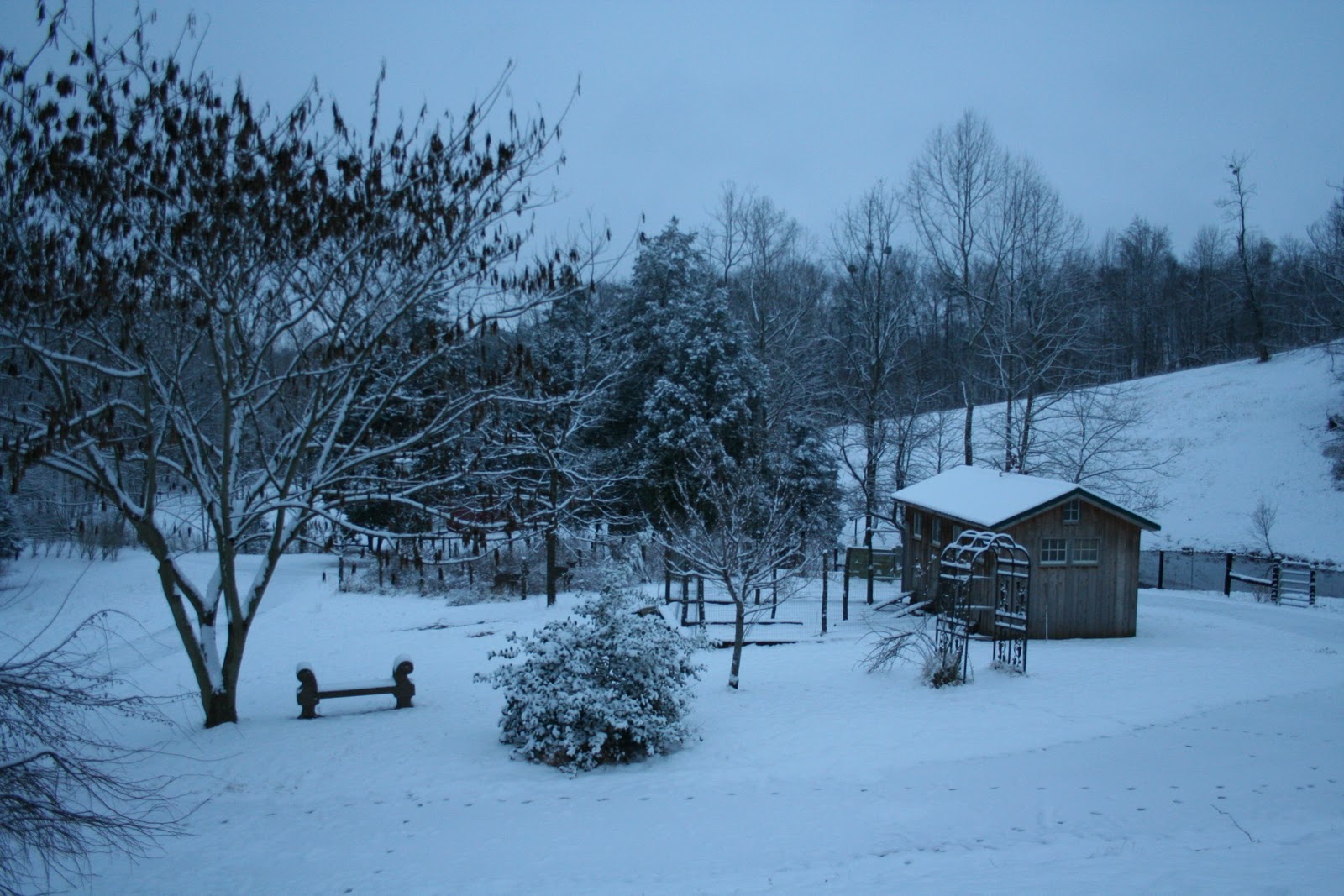
Today there are flurries on the ridge and a scurry of activity inside, too. Yesterday it was snowing starlings: thousands of them, in great whirls of blackness and clatter. I am reminded every year at this time of our dear Lucy, who the starlings seemed to lift heavenwards in the days after she died on December 3rd.
It is December, the darkest month of the year and yet a time of shining light within our hearts, within ourselves and our families, too. Let there be light and peace on Earth (please?)!
I just wanted to share this beautiful poem which arrived in my inbox today, as they do, every day, from The Writer's Almanac with Garrison Keillor: a most wonderful compendium of literary tidbits and poetry.
Manna
Everywhere, everywhere, snow sifting down
a world becoming white, no more sounds,
no longer possible to find the heart of the day,
the sun is gone, the sky is nowhere, and of all
I wanted in life – so be it – whatever it is
that brought me here, chance, fortune, whatever
blessing each flake of snow is the hint of, I am
grateful, I bear witness, I hold out my arms,
palms up, I know it is impossible to hold
for long what we love of the world, but look
at me, is it foolish, shameful, arrogant to say this,
Yesterday I cooked another large second turkey, just because it was at the bottom of the freezer. Time to "pantry up," as my friend Edie recently said (and "freezer up," too). Throughout the busy week ahead the juicy 25+ free ranger, from an Amish farm last winter, will be transformed into turkey salad, turkey soup, turkey pie, creamed turkey and sandwiches. [One reason is because I have an article deadline on December 1st and many book orders to process].
Today I'll be making turkey tetrazzini, with roasted beets and parsnips on the side and more rhubarb and pumpkin pies. We're having our Mennonite friends Melvin and Anna Hurst over for a Sunday supper of "leftovers" (well, not really, but that was the premise) later this afternoon and I'm looking forward to a nice leisurely "catch up" as I haven't seen either of them in a month. I'd even intended to host a "leftover" potluck for friends last night but it just never materialized.
As for food this Thanksgiving, back to our "simplicity" kick. I didn't make homemade cranberry sauce this year, or homemade rolls, or even cranberry nut bread. But the stuffing was arguably my best yet––from a recipe I came up with in college that I've been tweaking for the past 30 years. This year I added dried cherries and chopped pecans, as well as the Italian sausage, chopped apples and fresh cranberries that I have always included.
But we also had P I E!Homemade!By me! I say this so enthusiastically, and with great unabashed pride in my heart, because I've always had pie phobia–big time. The fillings are never the problem, it's the crust. Usually it is the one thing I ask guests to bring at Thanksgiving: dessert (and dessert at Thanksgiving usually equals pie). A few weeks ago my friend Rosemary back in New Hampshire sent me a pie dough recipe she had tweaked from Joanne Chang's Flour Bakery in Boston. It was the best pie dough, and easiest, I've made yet. If it sounds like there is a lot of butter, there is: but you're worth it (Rosemary also added a few more tablespoons to the original recipe). Rosemary, I should also add, was the frequent pie lady at our house (as well as my friend Linda, but I don't want to start a pie war between these two friends!).
Rhubarb pie awaits baking on Thanksgiving morning.
Rosemary's Second Amazing(ly Simple) Pie Dough
[Here is her first recipe: click here for blog archive!]
• 1 cup flour
• 1/2 tsp salt
• 10 Tbsps cold butter
• 1 egg yolk
• 2 Tbsps milk
Eli loves to help.
Put flour and salt into food processor, with blade (I used my plastic blade). Add cold butter, one tablespoon at a time, while pulsing. I combined the egg yolk and milk in a bowl and beat it quickly before adding to the flour-butter mixture in the food processor. Pulse all ingredients a few times until mixed and turn out onto floured board. Knead and flip several times and press with the back of your palm. (Rosemary said this is called "fraisaging" the dough–rhymes with "massage" and that's exactly what you are doing.) Then pat into a disk, wrap tightly in plastic wrap, and chill for at least an hour. The chilling is absolutely essential for ease of roll and a resulting flaky crust. [I doubled this for a 2-crust dough and you can also freeze your disks of dough for another day.]
A perfect pie trifecta!
When sufficiently chilled, roll out dough disk on a floured board to the desired size. You will find, having chilled it, that it will roll very nicely and should feel all satiny to the touch. After it bakes, your pie will have the flakiest, melt-in-your mouth flavor and texture. I can't wait to try it with turkey pot pie later this week! As much as I like Rosemary's other pie recipe, I might just be a convert to this one.
Thanksgiving without pumpkin pie is akin to sacrilege.